
“Long before the first bugles sounded from the barracks within the city, and the cantonments surrounding it, most of the people in the city were already awake” (opening lines).

A beautifully woven tapestry of prose, William Faulkner’s A Fable is nevertheless a convoluted, befuddling, and impenetrable novel. It stands forth like a towering mountain, daring readers to attempt a summit in the hopes of accomplishing something worthwhile, though unlike some of Faulkner’s other celebrated novels, A Fable simply does not offer much in the way of substance. A Fable is a pretentious, loquacious Christian allegory –the kind of novel that elicits eye-rolls rather than serious literary praise. Despite winning both the National Book Award and the Pulitzer Prize in 1955 (the first of two Pulitzer Prizes for Faulkner), in addition to Faulkner’s Nobel Prize for Literature several years earlier in 1949-1950, A Fable quickly fell out of favor among the cultured class, and it has since been critically panned as a failure. The book was Faulkner’s first major published work since his Nobel Prize win. As with many other winners of the Pulitzer, the honor in 1955 was likely bestowed in recognition of the author’s full oeuvre which included many other vastly superior works. Faulkner initially conceived of the story offhandedly while working on several Hollywood scripts. He then spent the better part of ten years carefully plotting its structure, even lining the walls of his study in Oxford, Mississippi with the days of the week as featured in the novel, hoping the book would be remembered as his magnum opus. However, today A Fable is often rightly ranked near the bottom of Faulkner’s novels. In spite of an avalanche of accolades, awarded primarily by cultural institutions fearful of neglecting one of America’s most celebrated writers, A Fable was best described by Charles Rolo writing in The Atlantic in 1954 as “a heroically ambitious failure.”
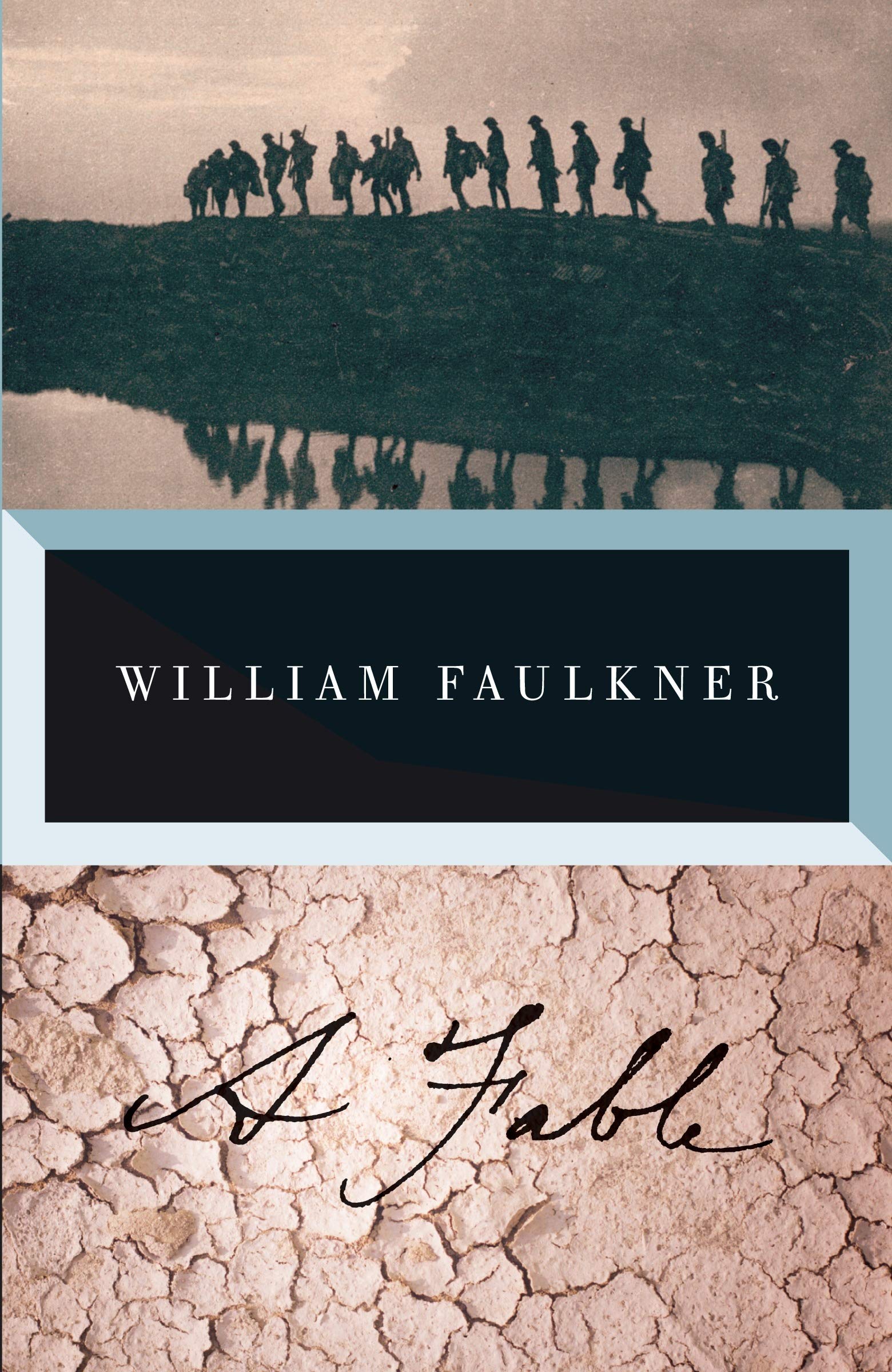
One of the few Faulkner novels not set in the fictional Mississippi region of Yoknapatawpha County (which was based on his own home county of Lafayette), A Fable takes place inside the French trenches during World War I. The year is 1918 and the beleaguered French soldiers are growing weary of fighting after four long years of bitter stalemate. Each chapter takes place across a week or so, with the inclusion of various fragmented flashbacks and flashforwards, as one entire French brigade commits mutiny. Led by a corporal and twelve of his companions, the regiment simply refuses to follow orders to launch another ill-fated offensive against the “Bosch.” Curiously, the opposing Germans also decline to launch a counter-offensive.
The impact of the mutiny as described below was felt months later:
“So he learned about the thirteen French soldiers almost at once –or rather, the thirteen men in French uniforms—who had been known for a year now among all combat troops below the grade of sergeant in the British forces and obviously in the French too, realising at that same moment that not only had he been the last man below sergeant in the whole Allied front to hear about them, but why: who five months ago had been an officer too, by the badges on his tunic also forever barred and interdict from the right and freedom to simple passions and hopes and fears –sickness for home, worry about wives and allotment pay, the weak beer and the shilling a day which wont event buy enough of that; even the right to be afraid of death—all that confederation of fellowship which enables man to support the weight of war; in fact, the surprise was that, having been an officer once, he had been permitted to learn about the thirteen men at all” (67-68).
Following the mutiny, the horde of three thousand French soldiers –strained and exhausted from fighting the war—marches into the nearby town of Chaulnesmont where they are met with scorn and rebuke. The soldiers learn that a contingent of thirteen superiors actually orchestrated the mutiny, four of whom are not Frenchman by birth (including the corporal-leader named Stefan, son of the supreme French general) and three of whom are not naturalized Frenchmen. Of those, only the corporal can even speak French. The corporal plays the role of Jesus in this tableau, while the other twelve serve as his “disciples.” The mutiny ultimately leads to a court marshal and an unceremonious execution in a crude allegory of Christ-like passion. There is a last supper before execution, a woman named Magda (the corporal’s wife), the old general (“generalissimo”) who serves as a stand-in for Pontius Pilate, the corporal appoints “Paul” Breton as his successor, he is taken to an old roman citadel where he is tempted, there is also a betrayer among the twelve, a man named “Piotr” disowns the corporal, and there are two women named Marthe and Marya, and so on.
In the end, the corporal is tied together with two others and shot by a firing squad of twenty soldiers. His final words are as follows, speaking to a third man: “’It’s all right,’ the corporal said. ‘We’re going to wait. We won’t go without you’” (405). In death, the two men slump forward while the corporal falls backward into a rubbish-filled trench as the barbed wire forms a crown around his head. The heavy-handed infusion of religious imagery is rife throughout the novel with recurring symbols of the cross and Holy Week and others. In the end, the corporal’s coffin is struck by artillery but his spirit is “resurrected” and reborn in a young runner who confronts the old general. These bizarre circumstances ultimately lead to the end of the war, despite the best efforts of the French and “Hun” generals who seek to perpetuate the war. There are also several extensive interludes in the novel concerning British flyboys and a Black American whose saga with an injured racehorse is told in great detail. Unfortunately, I did not find much of anything worthwhile in this novel.
Interestingly enough, Faulkner himself never fought in a war. Apparently, he attempted to enlist in the US Army and British Forces during World War I but he was rejected. He joined the Canadian RAF but never saw any action. Nevertheless, Faulkner had a penchant for spinning elaborate yarns about being a pilot during the war and sustaining a battle wound. Aside from his work in Hollywood, Faulkner’s inspiration for A Fable likely came from boyhood stories he heard of the Battle of Verdun as well as Humphrey Cobb’s novel Paths of Glory (which was later made into a celebrated movie by Stanley Kubrick). At any rate, pretentious in the extreme, with plenty of on-the-nose religious imagery, allegories like A Fable are rarely successful in my view. Writing in the New York Times on May 25, 1969, Joseph Blotner (a professor at UNC Chapel Hill) wrote: “Although it was admired and honored, ‘A Fable’ did not achieve the same power or poignancy inherent in his other major creations… Starting as a film property, it had evolved from synopsis to fable and from allegory to novel. And finally it had become for Faulkner, by then a world literary figure, a massive vehicle for a costly, courageous summary statement of his view of the human condition.”
Notable Quotations:
“’The Boche doesn’t want to destroy us, any more than we would want, could afford, to destroy him. Can’t you understand: either of us, without the other, couldn’t exist?” (27).
“The troops. All of them. Defying, revolting, not against the enemy, but against us, the officers…” (41).
“They could execute only so many of us before they will have worn out the last rifle and pistol and expended the last live shell” (69).
“They had begun to arrive yesterday, Tuesday, when news o the regiment’s mutiny and arrest first reached the district and before the regiment itself had even been brought back to Chaulnesmont for the old supreme generalissimo himself to decide its fate” (126).
“It had not failed in an attack: it had simply refused to make one, to leave the trench, not before nor even as the attack started” (127).
On the 1955 Pulitzer Prize Decision
In addition to A Fable winning the Pulitzer Prize for Fiction in 1955, this was also the year that Tennessee Williams won the Pulitzer Prize for Drama for Cat on a Hot Tin Roof, and Carlos Williams won the Pulitzer for his celebrated collection of poetry. Faulkner’s A Fable was the first novel to win the Pulitzer Prize since Hemingway won in 1953 for The Old Man and the Sea (no award was given in 1954). At the time, Hemingway and Faulkner were chief literary rivals.
The award for A Fable came with yet another controversial choice behind the scenes. The jury had selected Milton Lott’s The Last Hunt as their top choice for the prize, though Faulkner’s A Fable was a runner-up. “There are portions of this novel that seemed to us to be close to greatness,” wrote jury member Francis Brown in his jury report submitted to John Hohenberg, “but I think we are agreed that it fails ultimately because of its inability to communicate with the reader. We also have a feeling that Faulkner has done better in the past and that it would be a mistake to give him a Pulitzer award for something less than what he has done before.”
However, Pulitzer Prize Administrator John Hohenberg –shocked at the jury for considering a novel about the extinction of the buffalo over Faulkner– eventually took note of a spirited discussion among the Pulitzer advisory board about this decision, particularly an impassioned speech by Hodding Carter who spoke on behalf of his fellow Mississippian who was long overdue for the award, despite A Fable being an obviously mediocre work. Hohenberg later wrote: “I needed only a glance around the table to determine that Faulkner, after being ignored for his greatest works finally would be given a Pulitzer Prize as our great living novelist. And so it turned out, by a unanimous vote.” Thus, the advisory board overrode the jury’s selection, much to the frustration of certain jurors, particularly Francis Brown and Carlos Baker who both called John Hohenberg to voice their disapproval at the reversal. Hohenberg later noted that jury member Carlos Baker “said he’d been so upset at the Lott reversal that he worked in his garden for an hour with his rapid-digger, felt better, and said he’d write an encouraging letter to Milton Lott.” Perhaps Faulkner’s two late career Pulitzer Prizes were merely attempts at atonement by the Pulitzer Prize for overlooking his earlier works like The Sound and the Fury and Absolom, Absolom!
The 1955 Pulitzer Fiction Jury consisted of the following members:
- Carlos Baker (1909-1987) was a notable man of letters. He was the former Woodrow Wilson Professor of Literature at Princeton (his PhD dissertation explored the influence of Spencer on Shelley’s poetry). He wrote a critically lauded biography of Ernest Hemingway which was nevertheless criticized by Hemingway’s third wife Martha Gellhorn. Baker also wrote well-regarded biographies of Percy Bysshe Shelley and Ralph Waldo Emerson. Baker was the teacher of A. Scott Berg, the contemporary biographer who has written bestselling books about Max Perkins, Samuel Goldwyn, Katharine Hepburn, Woodrow Wilson, Charles Lindbergh (which later won the Pulitzer).
- Francis “Brownie” Brown (1904-1995) served as editor of the New York Times Book Review from 1949-1971. During his tenure, he oversaw expansive changes to the Book Review as the American writing industry expanded drastically with rapid increases of public literacy. He commissioned contributions by important American writers like James Baldwin and Saul Bellow, and penned several historical/biographical books.
- Irwin Edman (1896-1954) was a Professor of Philosophy at Columbia University. Broadly loved by his students, Herman Wouk (Columbia alumnus, class of 1934) dedicated his first novel to Edman. Throughout his career, Edman contributed to a wide array of literary journals, including The New Yorker, The Atlantic Monthly (later renamed The Atlantic), The New York Times Magazine, Harper’s Weekly, Commentary, and Horizon. He also served on the board of the National Institute of Arts and Letters.
According to John Hohenberg: “The newly reconstituted Advisory Board faced none of the obstacles of its predecessors during the 1955-1965 period, particularly in fiction. The terms of the Plan of the Award were now clear: ‘For distinguished fiction in book form during the year by an American author, preferably dealing with American life.’ There was no longer any feeling that the Pulitzer Prize novel must be wholesome. Nor was there any Nicholas Murray Butler to threaten a Trustees’ veto of any novel that reflected what he considered to be deplorable morals and used regrettable language. Not once during his long association with the Board did President Grayson Kirk take any leading part in the continuing argument over the values of the American novel. He was primarily a historian and he remained in his own bailiwick.”
He further noted that, by now “the mid-Victorian spirit wasn’t running rampant” any longer and “every Board member at the oval table beneath the glowing Statue of Liberty window knew quite well that the fiction category had been the most criticized of all the Pulitzer awards and that the selection in fiction, accordingly, would be given the closest scrutiny. It probably made the Board as a whole more careful and reserved in its judgements than it otherwise would have been during at least a part of the decade.”
Who Is William Faulkner?
William Cuthbert Faulkner (1897-1962) was born in 1897 in New Albany, Mississippi, the eldest of five children in an upper middle-class family (though not quite considered among the “old feudal cotton aristocracy”). The family relocated to Oxford, Mississippi in 1902 where Faulkner would reside nearly the entirety of his life. Initially, Faulkner was apparently a great student, however as time wore on, he became a shy, withdrawn child. He wrote poetry and was introduced to the writing of James Joyce by Phil Stone, the child of a prominent old guard Oxford family, who attended Yale and opened Faulkner’s eyes to the likes of Sherwood Anderson, Robert Frost, and Ezra Pound.

While many of the writers in his generation became expats, living abroad in places like Paris, Faulkner remained in the United States though he did seek out culture among the bohemians in the French Quarter of New Orleans, Louisiana. During this period, his chief influences changed from Victorian to modernist in the vein of Hemingway and Fitzgerald –a drastic improvement in style. With the help of Sherwood Anderson, Faulkner published his first novel, Soldier’s Pay in 1926. This was followed by Flags in the Dust in 1927 (the first of his books set in Yoknapatawpha County), and while writing short stories, Faulkner published The Sound and the Fury in 1928. In 1929, he married Estelle Oldham who had two children from a previous marriage. They had two daughters together, however one died a mere nine days after being born.
Along with The Sound and the Fury, Faulkner’s other praised novels include: As I Lay Dying (1930), Light in August (1932), Absalom, Absalom! (1936), Go Down, Moses (1942), and The Reivers (1962). In need of money, Faulkner also headed out west to California where he worked as a screenwriter, including for a film adaptation of Hemingway’s To Have and Have Not starring Lauren Bacall and Humphrey Bogart, who also starred in The Big Sleep which Faulkner worked on. He befriended director Howard Hawks (he had an affair with Hawks’ secretary) and was often found drinking mint juleps at a collection of bars.
With the outbreak of World War II, Faulkner’s creative inspiration struggled (as with World War I, Faulkner was again rejected for frontline service). However, in later years Faulkner saw a resurgence and reappraisal of his works, especially when Malcolm Cowley published a compilation entitled “The Portable Faulkner.” In 1949, Faulkner won the Nobel Prize for Literature –he delivered his address at the following year’s banquet alongside Bertrand Russell. While in Stockholm, Faulkner had an affair with Else Jonsson, widow of journalist Thorsten Jonsson, who was apparently instrumental in Faulkner being awarded the Nobel Prize. After winning the Nobel Prize, accolades began to pour in –twice winning the National Book Award, two Pulitzer Prizes, and he received the Chevalier de la Légion d’honneur medal from the government of France.
Between 1961-1962, Faulkner suffered a series of falls, including from a horse, which led to thrombosis and eventually a fatal heart attack on July 6, 1962. He is buried alongside his family in St. Peter’s Cemetery in Oxford, Mississippi.
In 1956, William Faulkner was interviewed by Jean Stein for the Paris Review. Although there are many interesting things he discusses in that interview, I offer a particular quotation for reflection:
“…if we Americans are to survive it will have to be because we choose and elect and defend to be first of all Americans; to present to the world one homogeneous and unbroken front, whether of white Americans or black ones or purple or blue or green. Maybe the purpose of this sorry and tragic error committed in my native Mississippi by two white adults on an afflicted Negro child [Emmett Till] is to prove to us whether or not we deserve to survive. Because if we in America have reached that point in our desperate culture when we must murder children, no matter for what reason or what color, we don’t deserve to survive and probably won’t.”
Film Adaptation:
- None.
Further Reading:
- The Sound and the Fury (1929)
- As I Lay Dying (1930)
- Light in August (1932)
- Absalom, Absalom! (1936)
- The Hamlet (1940)
- Go Down, Moses (1942)
- A Fable (1954), Pulitzer Prize-winner
- The Reivers (1962) Pulitzer Prize-winner
Literary Context in 1954-1955:
- Nobel Prize for Literature (1954): awarded to the American author Ernest Hemingway (1899–1961) “for his mastery of the art of narrative, most recently demonstrated in The Old Man and the Sea, and for the influence that he has exerted on contemporary style.”
- National Book Award (1955): A Fable by William Faulkner, in addition to its Pulitzer Prize win.
- Per Publishers Weekly, the top bestseller in 1954 was Not as a Stranger by Morton Thompson.
- Kingsley Amis’s first novel, the satirical campus novel Lucky Jim, was published.
- The first public celebration of “Bloomsday” took place in Dublin.
- The first volume of J. R. R. Tolkien’s epic The Lord of the Rings – The Fellowship of the Ring was published in London by George Allen & Unwin.
- William Golding’s first novel, Lord of the Flies, was published.
- Pierre Boulle’s The Bridge over the River Kwai was published.
- Ian Fleming’s Live and Let Die was published.
- Richard Matheson’s I Am Legend was published.
- James A. Michener’s Sayonara was published.
Did The Right Book Win?
A Pulitzer Prize for one of Faulkner’s more celebrated novels would have been more fitting than A Fable in my opinion –I simply did not care for A Fable (I would rank it among my least favorite Pulitzer Prize-winners). Unfortunately, 1954 was not a particularly stellar year for American literature so I am also not sure of an ideal replacement.
Faulkner, William. A Fable. Franklin Mint Corporation (reprinted by permission of Random House), The Franklin Library, Pennsylvania (1976).