
Hercule Poirot Series

1. The Mysterious Affair at Styles (1920) – 5/5
Arthur Hastings has recently been “invalided” home from the warfront and he visits Styles Court, the lavish country home of his friend’s mother Emily Agnes Inglethorp. In the local town of Styles St. Mary, Hastings bumps into an old acquaintance, the famed Belgian detective Hercule Poirot. This is fortuitous as this idyllic country scene is quickly disrupted when Mrs. Inglethrop is found dead in her bed, poisoned with strychnine and her doors bolted from the inside. Who killed Mrs. Inglethorpe? And why?

2. The Murder on the Links (1923) – 4/5
Hastings is working as a private secretary for an MP and Poirot is working as a private detective when they receive an urgent message from a South American millionaire residing in France named Monsieur Paul T. Renauld. Mr. Renauld writes that he fears for his life so Poirot and Hastings quickly travel to meet him. But when they arrive in France, they learn that Mr. Renauld has already been murdered! He was stabbed in the back and his body was found in a shallow grave alongside a nearby golf course.

3. Poirot Investigates (1924, short story collection) – 4/5
As the third official book in Agatha Christie’s Hercule Poirot series, Poirot Investigates offers a charming, concise collection of short stories showcasing Poirot’s unrequited “grey cells” and his unparalleled “method” of sleuthing. In total, there are fourteen short stories in this collection, many of them featuring tales of mysterious disappearances, jewelry heists, murders, stolen inheritances, ghostly apparitions, and even the kidnapping of the Prime Minister of England.

4. The Murder of Roger Ackroyd (1926) – 5/5
With The Murder of Roger Ackroyd, Dame Agatha Christie presents her seminal work, perhaps the most comprehensive challenge to a mystery reader’s natural proclivity and prejudice for a certain type of trustworthy character –it delivers one of the most shocking twist-endings in the whodunit murder-mystery genre. Uniquely narrated by Dr. James Sheppard, a small-town surgeon in the rural English village of King’s Abbot (where Hercule Poirot has recently retired), the village is rocked when a local country squire named Roger Ackroyd has been found murdered in his study.

5. The Big Four (1927) – 3/5
Hercule Poirot meets James Bond! Initially written as a series of short stories, The Big Four marks a significant departure from Agatha Christie’s classic English country house whodunnit mystery novels. Seemingly foreshadowing the pulpy works of Ian Fleming, this globe-trotting espionage thriller leads Hastings and Poirot on a wild, rollicking adventure as they slowly uncover a series of dangerous clues leading to a mysterious international organization called “The Big Four” which is allegedly bent on world domination.
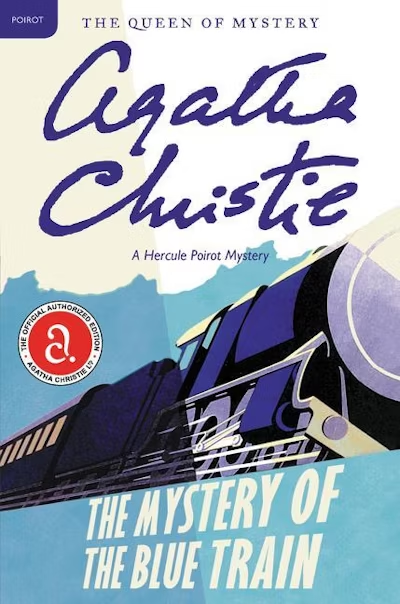
6. The Mystery of the Blue Train (1928) – 4/5
The Mystery of the Blue Train concerns a locomotive jewel heist aboard The Blue Train. Ruth Kettering is killed and her prized ruby (a gift from her father), the “Heart of Fire” which was once worn by Catherine the Great, is stolen by a mysterious masked figure wearing a white-haired wig going by the name “M. le Marquis.” Who killed Ruth and stole her jewel? Luckily, Ruth’s father Mr. Van Aldin hires Hercule Poirot (this time sans Hastings) to solve the mystery.

7. Black Coffee (1930 play) – 4/5
While perhaps not technically part of Agatha Christie’s Poirot canon, Black Coffee was a stage play written by Christie and later adapted into a novel by Charles Osborne. In it, Sir Claud Amory is a famous scientist who is “working on a formula to bombard the atom.” This could change the future trajectory of nuclear warfare. But when he finds his secret formula has gone missing from his safe during a dinner party, he locks all of his guests inside the library and requests the missing paperwork be returned. The lights go out, Sir Claud is found dead, and it’s up to Poirot and Hastings to solve this whodunnit mystery.

8. Peril at End House (1932) – 5/5
Peril at End House takes us down to the beautiful Cornish coastal town of St. Loo in the south of England where a retired Poirot and his “mon ami” Hastings, back from his ranch in the Argentine, are on holiday. Here, they quite literally stumble upon a pretty young woman named Miss Nick Buckley who lives at “End House,” an old coastal mansion she has inherited from her family. But as Poirot and Hastings get to know Nick Buckley, they learn someone is trying to kill her.

9. Lord Edgware Dies (1933) also published as Thirteen at Dinner – 5/5
Poirot and Hastings attend a London theatre and witness a performance by American sketch impressionist, Carlotta Adams, known for her amusing satire of Jane Wilkinson. Tonight none other than Jane Wilkinson is in the audience, she is the estranged wife of Lord Edgware, a darkly mysterious man. She convinces Poirot and Hastings to persuade her husband to agree to a divorce, but shortly after their meeting, Lord Edgware is found dead, stabbed in the back of the neck!

10. Murder on the Orient Express (1934) also published as Murder in the Calais Coach – 5/5
Hercule Poirot makes a frigid mid-winter trip from Aleppo, Syria back to Western Europe. After he boards the Simplon Orient Express, he notices suspicious behavior among his fellow travelers. One of them, Samuel Ratchett, approaches Poirot with concerns for his own safety. During the night, Poirot learns that Ratchett has been murdered, he was stabbed about twelve times. Who killed Ratchett? And why?

11. Three Act Tragedy (1934) also published as Murder in Three Acts – 4/5
Three Act Tragedy is laid out like a theatrical program. It opens with a playbill and unfolds like a stage performance. Three Act Tragedy concerns the sudden death of two seemingly unrelated individuals at different dinner parties: a local clergyman named Stephen Babbington and a celebrated doctor named Sir Bartholomew Strange. Although Hercule Poirot is absent for most of the story, he and Hastings make their triumphant appearance towards the end to solve the puzzle.

12. Death in the Clouds (1935) also published as Death in the Air – 4/5
Hercule Poirot (sans Hastings) boards a flight dubbed the “Prometheus” headed from Paris (Le Bourget aerodome) to London (Croydon). But toward the end of the flight, an older woman, who just so happens to be one of the most prominent money-lenders in Paris, is found dead! Was she stung by a loose wasp on the plane? Or could she have been murdered by a rare South American poison blowdart?
The A.B.C. Murders (1936) also published as The Alphabet Murders
Murder in Mesopotamia (1936)
Cards on the Table (1936)
Murder in the Mews (1937, short story collection) also published as Dead Man’s Mirror
Dumb Witness (1937) also published as Poirot Loses a Client
Death on the Nile (1937) also published as Murder on the Nile and as Hidden Horizon
Appointment with Death (1938)
Hercule Poirot’s Christmas (1938) also published as Murder for Christmas and as A Holiday for
The Regatta Mystery and Other Stories (1939, short story collection)
Sad Cypress (1940)
One, Two, Buckle My Shoe (1940) also published as An Overdose of Death and as The Patriotic
Evil Under the Sun (1941)
Five Little Pigs (1942) also published as Murder in Retrospect
The Hollow (1946) also published as Murder after Hours
The Labours of Hercules (1947, short story collection)
The Witness for the Prosecution and Other Stories (1948, short story collection)
Taken at the Flood (1948) also published as There Is a Tide
Three Blind Mice and Other Stories (1950, short story collection)
The Under Dog and Other Stories (1951, short story collection)
Mrs McGinty’s Dead (1952) also published as Blood Will Tell
After the Funeral (1953) also published as Funerals are Fatal
Hickory Dickory Dock (1955) also published as Hickory Dickory Death
Dead Man’s Folly (1956)
Cat Among the Pigeons (1959)
The Adventure of the Christmas Pudding (1960, short story)
Double Sin and Other Stories (1961, short story collection)
The Clocks (1963)
Third Girl (1966)
Hallowe’en Party (1969)
Elephants Can Remember (1972)
Poirot’s Early Cases (1974, short story collection)
Curtain (written about 1940, published 1975) also published as Curtain: Poirot’s Last Case
Problem at Pollensa Bay and Other Stories (1991, short story collection)
The Harlequin Tea Set (1997, short story collection)
While the Light Lasts and Other Stories (1997, short story collection)
Miss Marple Series
- The Murder at the Vicarage (1930)
- The Body in the Library (1942)
- The Moving Finger (1943)
- A Murder Is Announced (1950)
- They Do It with Mirrors (1952)
- A Pocket Full of Rye (1953)
- 4.50 from Paddington (1957)
- The Mirror Crack’d from Side to Side (1962)
- A Caribbean Mystery (1964)
- At Bertram’s Hotel (1965)
- Nemesis (1971)
- Sleeping Murder (1976)
Tommy and Tuppence
- The Secret Adversary (1922 novel)
- Partners in Crime (1929 short story collection)
- N or M? (1941 novel)
- By the Pricking of My Thumbs (1968 novel)
- Postern of Fate (1973 novel)
Other Agatha Christie Novels
- The Man in the Brown Suit (1924)
- Giant’s Bread (1930)
- The Floating Admiral (1931)
- The Sittaford Mystery (1931)
- Unfinished Portrait (1934)
- Why Didn’t They Ask Evans? (1934)
- Parker Pyne Investigates (1934 short story collection)
- And Then There Were None (1939)
- The Crime in Cabin 66 (1943 short story collection)
- Absent in the Spring (1944)
- Death Comes as the End (1945)
- Sparkling Cyanide (1945)
- The Rose and the Yew Tree (1948)
- Crooked House (1949)
- They Came to Baghdad (1951)
- A Daughter’s a Daughter (1952)
- Destination Unknown (1954)
- The Burden (1956)
- Ordeal by Innocence (1958)
- The Pale Horse (1961)
- Endless Night (1967)
- Passenger to Frankfurt (1970)
Resources:
- The Life and Crimes of Agatha Christie (1979) by Charles Osbourne
- Agatha Christie: A Mysterious Life (2018) by Laura Thompson