
“Grandfather said: This is the kind of a man Boon Hogganbeck was…”

Speaking to his grandson in 1961, the elder Lucius Priest offers a personal “reminiscence” about an adventure he once undertook in 1905 when he was still just a naïve eleven-year-old boy. As a distant relative of the McCaslin/Edmonds family (which was featured in William Faulkner’s Go Down, Moses) Lucius works for his father’s livery business in Jefferson which makes deliveries by “Negro drivers” to the backdoors of a variety of grocers, hardware stores, and farm suppliers. Young Lucius’s grandfather is Boss Priest, an elder statesman and president of the local bank in Faulkner’s fictional Yoknapatawpha county in Mississippi. Boss Priest is a stalwart luddite who laments the dawn of the automobile age –once again, a Pulitzer Prize-winning novel presents a skeptical view of the automobile (this theme was rife throughout the early winners, though perhaps most notably in Booth Tarkington’s The Magnificent Ambersons). To Boss Priest, the dawn of the automobile serves as “a nightmare vision of our nation’s vast and boundless future in which the basic unit of its economy and prosperity would be a small mass-produced cubicle containing four wheels and an engine” (28). And he further foretells that “twenty-five years from now there won’t be a road in the county you can drive an automobile on in any weather… it will cost a great deal of money… the road builders will issue bonds. The bank will buy them…” (41). Comforted by a familiar world of horse-drawn carriages and railroads, the older generation is dismayed by the rise of the personal automobile –and this fear is especially acute for a family that runs a livery stable like the Priests. Nevertheless, Boss Priest is soon compelled to purchase a car, one of the very first automobiles in Jefferson, though he rarely uses it because it represents “the mechanised, the mobilised, the inescapable destiny of America” (94).
One day, after Lucius finishes collecting bills for his father (paid ten cents per week), one of the Priest’s chaotic, unpredictable drivers named Boon Hogganbeck suddenly bursts into the office to steal a gun and kill another driver named Ludus who insulted him. It is in this tempestuous moment that Faulkner decides to introduce us to this comically erratic young man named Boon, who “was tough, faithful, brave and completely unreliable; he was six feet four inches tall and weighed two hundred and forty pounds and had the mentality of a child” (19). He is akin to a “corporation, a holding company” held in trust by three prominent families in the area who each agree to take responsibility for him when things inevitably go awry. His grandmother had been “the daughter of one of old Issetibbeha’s Chickasaws who married a white whiskey trader” but depending on how much Boon has had to drink, he sometimes claims to be at least “ninety-nine one-hundredths Chickasaw” or else entirely absent even one drop of Indian blood. No one truly knows Boon’s origins or his age, since he was initially found living by himself in the woods. Regarding Boon’s visage, Lucius notes that “in its normal state his face never looked especially gentle or composed” like a “big, ugly florid walnut tough walnut-hard face.” In this particular dispute, Lucius watches as his father (Maury Priest) offers a bond over the two boys in order to preserve the peace, and in some ways, this serves as a metaphor for the whole novel –Lucius’s struggle to live the life of gentlemanly virtue, to embrace the code of chivalry, and maintain peace and order.
Boon is utterly enamored with the Priest’s new automobile –a Winton Flyer– and when the death of Lucius’s maternal Grandfather Lessep sends the rest of his family away to St. Louis by train for four days, Boon “borrows” the Priest’s Winton Flyer and persuades Lucius to join him on a wild, rollicking picaresque adventure to Memphis –nearly twenty-four hours away—as they get stuck in the mud at Hell Creek and pay an exorbitant amount of money to retrieve the car with help from a man with color blind mules, only to discover that Ned McCaslin (Boss Priest’s black coachman) has been a stowaway onboard their car this whole time. They stay the night at Miss Ballenbaugh’s country store before departing for Memphis where “the very land itself seemed to have changed. The farms were bigger, more prosperous, with tighter fences and painted houses and even bars; the very air was urban” (94).
Throughout the novel, Lucius struggles with the concept of Virtue and what he calls “Non-virtue.” He doesn’t want to keep telling lies, but he also wants to grow up and experience the world a bit. Like Doctor Faustus before him, Lucius allows himself to succumb to “Non-virtue” just this once, but he is unwittingly led by Boon to a seedy bordello in Memphis where Boon plans to meet-up with his paramour, a prostitute named Miss Corrie (or Everbe Corinthia) who works under Miss Reba. Boon says, “We’re going to a kind a boarding house I know… you’ll like it.” This bordello is run by a sleazebag named Mr. Binford –and in a strange digression, the elder Lucius reflects fondly on his memories of Mr. Binford: “You see? How much ahead of his time Mr Binford was? Already a Republican. I don’t mean a 1905 Republican –I don’t know what his Tennessee politics were, or if he had any—I mean a 1961 Republican. He was more: he was a conservative. Like this: a Republican is a man who made his money; a Liberal is a man who inherited his; a Democrat is a barefooted Liberal in a cross-country race; a Conservative is a Republican who has learned to read and write” (109). With this in mind, is the aging Lucius a reliable narrator? At any rate, returning to 1905, upon arrival at the bordello everything seems to go wrong for the boys –Ned loses the car and steals a horse named Lightning leading to much frustration, while Lucius’s hand is sliced in a fight with another boy at the brothel named Otis (Miss Corrie’s nephew) who claims to run a peepshow side business where boys can watch all the “pugnuckling” going on. In a quixotic fit of rage, Lucius battles to defend Miss Corrie’s honor and, inspired by his honorable display of chivalry, she promises to give up her life as a prostitute.
The group then hatches a plan to retrieve the family car by racing Lightning (whose real name is Coppermine) at the tracks in Parsham. Here, they encounter a corrupt, lusty police officer named Butch who locks Boon up in jail and threatens to cause all sorts of problems, until Miss Corrie breaks her promise to stop prostituting and gives herself over Butch in order to save the group. Much to everyone’s surprise, Lightning wins the first race with Lucius in the saddle –but suddenly, he is entirely shocked to find his grandfather, Boss Priest, watching him from the sidelines. That evening, Lucius is ashamed of himself but Ned explains that he once trained mules and knows a secret ingredient to win the race –feeding Lightning sardines. Boss Priest, now embroiled in this scheme, decides to bet $500 on Lightning at the racetrack the following day, but intentionally throws the race, revealing he betted against Lightning in an effort to get back at Grandfather Priest and to help pay off his cousin Bobo’s gambling debt to a white man (bear in mind –set in Mississippi and Tennessee in 1905– The Reivers is very much informed by the racist legacy of the Jim Crow South).
In the end, Boss Priest retrieves his car anyway and Boon drives Grandfather, Boon, Miss Corrie, and Lucius back to Jefferson. In an amusing epilogue of sorts, Miss Corrie and Boon are married and soon have a baby whom they name: Lucius Priest Hogganbeck.
The Reivers was William Faulkner’s final novel, published barely a month before his death, and it offers a whimsical romp through frequent Faulknerian literary haunts, especially the familiar characters of Yoknapatawpha county in Mississippi. After having written many weighty, impenetrable, tragic novels, it seems only fitting that Faulkner would end his career with the jovial jaunt of a trio of ne’er-do-wells. Perhaps Faulkner’s The Reivers is akin to Shakespeare’s The Tempest –turning, in the winter of his career, to comedy in order to playfully address some of his more serious questions. Etymologically, a “Reiver” is an old Anglo-Scottish word that comes down to us meaning a “robber,” “plunderer,” “raider.” In particular, with respect to historical advent of “Border Reivers,” there was an element of moral degradation or even a threat of civilizational loss. These themes also loom heavily over The Reivers as the three boys are robbers of the Priest family car (and Ned also steals a horse before swindling Boss Priest out of his money) but on a much deeper level, Lucius is robbed of his boyhood innocence. He laments the meaning of “non-Virtue” wherein “the whole edifice of entendre-de-noblesse collapsed into dust” and his grandfather reminds him that “A gentleman can live through anything. He faces anything. A gentleman accepts the responsibility of his actions and bears the burden of their consequences, even when he did not himself instigate them but only acquiesced to them, didn’t say No though he knew he should” (302).
Dedicated to Victoria, Mark, Paul, William, Burks (Faulkner’s grandchildren) this whimsical meditation on moral character is not generally regarded as one of Faulkner’s masterworks. And many have speculated it was likely awarded the Pulitzer Prize in recognition of Faulkner’s entire literary corpus, much of which was sorely overlooked by the Pulitzer Prize. Despite seeming to be mere wistful comedic reflections on the surface, I still think readers will find something to glean in the pages of William Faulkner’s final novel.
Notable Quotations:
“I’m sure you have noticed how ignorant people beyond thirty and forty are. I don’t mean forgetful… there are some things, some of the hard facts of life, that you don’t forget, no matter how old you are. There is a ditch, a chasm; as a boy you crossed it on a footlog. You come creeping and doddering back at thirty-five or forty and the footlog but at least you don’t step out onto that empty gravity that footlog once spanned” (5).
“…by 1980 the automobile will be as obsolete to reach wilderness with as the automobile will have made the world it seeks” (21).
“My grandfather didn’t want an automobile at all; he was forced to buy one. A banker, president of the older Bank of Jefferson, the first bank in Yoknapatawpha County, he believed then and right on to his death many years afterward, by which time everybody else even in Yoknapatawpha County had realized that the automobile had come to stay, that the motor vehicle was insolvent phenomenon like last night’s toadstool and, like the fungus, would vanish with tomorrow’s sun” (25).
“In fact, at this moment I wished I had never heard of Memphis or Boon or automobiles…” (57).
“We were worse than amateurs: innocents, complete innocents at stealing automobiles even though neither of us would have called it stealing since we intended to return it unharmed; and even, if people, the world (Jefferson anyway) had just let us alone, unmissed” (62).
“Because the die was indeed cast now; we looked not back to remorse or regret or might-have-been; if we crossed Rubicon when we crossed the Iron Bridge into another country, when we conquered Hell Creek we locked the portcullis and set the bridge on fire. And it did seem as through we had won to reprieve as a reward for invincible determination, or refusal to recognize defeat when we faced it or it faced us. Or maybe it was just Virtue who had given up, relinquished us to Non-virtue to cherish and nurture and coddle in the style whose right had won with the now irrevocable barter of our souls” (93-94).
“Because women are wonderful. They can bear anything because they are wise enough to know that all you have to do with grief and trouble is just go on through them and come out on the other side. I think they can do this because they not only decline to dignify physical pain by taking it seriously, they have no sense of shame at the idea of being knocked out” (111).
“…who serves Virtue works alone, unaided, in a chilly vacuum of reserved judgment; where, pledge yourself to Non-virtue and the whole countryside boils with volunteers to help you” (143).
“And suddenly there was something wrong with me too. It was like I didn’t know what it was yet: only that there was something wrong and in a minute now I would know what and I would hate it; and suddenly I didn’t want to be there at all, I didn’t want to be in Memphis or ever to have heard of Memphis: I wanted to be at home” (154).
“I wanted my mother. Because you should be prepared for experience, knowledge, knowing: not bludgeoned unaware in the dark as by a highwayman or footpad. I was just eleven, remember. There are things, circumstances, conditions in the world which should not be there but are, and you can’t escape them and indeed, you would not escape them even if you had the choice, since they too are a part of Motion, of participating in life, being alive. But they should arrive with grace, decency. I was having to learn too much too fast, unassisted: I had nowhere to put it, no receptacle, pigeonhole prepared yet to accept it without pain and lacerations” (155).
“And suddenly I was anguished with homesickness, wrenched and wrung and agonized with it: to be home, not just to retrace but to retract, obliterate: make Ned take the horse back to wherever and whoever and however he had got it and get Grandfather’s automobile and take it back to Jefferson” (174-175).
“I mean, nobody likes to be licked, but maybe there are times when nobody can help being; that all you can do about it is not quit” (251).
“A gentleman always does [live with it]. A gentleman can live through anything. He faces anything. A gentleman accepts the responsibility of his actions and bears the burden of their consequences, even when he did not himself instigate them but only acquiesced to them, didn’t say No though he knew he should” (302).
On the 1963 Pulitzer Prize Decision
With the victory of The Reivers in 1963, William Faulkner posthumously joined the rare cohort of two-time Pulitzer Prize-winners in the Fiction category, which currently includes four writers –Booth Tarkington, William Faulkner, John Updike, and Colson Whitehead. According to former Pulitzer Prize Administrator, John Hohenberg’s (in his Pulitzer Diaries), the Pulitzer Board set aside a Fiction Jury recommendation of awarding the prize in 1963 to Katherine Ann Porter for her novel Ship of Fools (about a group of characters sailing from Mexico to Europe aboard a German passenger ship as a metaphor for the rise of Nazism) and instead granted the award posthumously to William Faulkner’s The Reivers. The jury also offered commendation to A Long and Happy Life by Reynolds Price.
The jury report stated the following: “As it happened, 1962 was also the year which saw the publication of William Faulkner’s The Reivers, his last novel and also one of his most appealing. A genial comedy of three Mississippi innocents on a visit to Memphis, it contains a minimum of the rhetoric ad moralizing which characterized Faulkner’s later writing, The Reivers, is, in fact, a sunny interlude (the last, alas) inn the shaping of the vast Yoknapatawpha saga, in which Faulkner for once sounds relaxed, as though he were yarning to a circle of friends in that soft, elliptical draw of his. The Reivers has been described as ‘a perfect book for that last goodnight,’ and we agree.”
The Fiction Jury in 1963 consisted of the same two jury members as the prior couple of years:
- John Barkham (1908-1998) was originally born in South Africa on an ostrich farm, before later migrating to the United States where he became a historical book reviewer, focusing primarily on books about Africa. According to his obituary in The New York Times, in his heyday, Mr. Barkham could deliver a stream of 4-6 book reviews per week. He would typically sit back in his Eames leather reading chair at 3pm, and once finished reading, he would handwrite his review of the book before typing it up again on his typewriter. His writing appeared in numerous publications including TIME, The New York Times Book Review, The New York Post and others. Mr. Barkham served on many Pulitzer juries in the categories of Fiction, Nonfiction, and Biography over a period of approximately 20 years.
- Irita Van Doren (1891-1966) was one of the leading literary lights in New York City for more than 40 years. She began her career on the editorial staff at The Nation in 1919 before moving to The New York Herald Tribune Books for some 35 years, where she worked under editor Stuart P. Sherman (who served as a Pulitzer Prize Juror in 1920s). When he passed away in 1926, Mrs. Van Doren succeeded him as editor of The Herald Tribune, and she quickly “won respect for her editorial judgement, for her punctuality in printing book news and reviews and for her policy of representing all shades of taste and opinion in books and reviewers.” For example, it was she who selected Lewis Gannett as the paper’s long-serving daily book critic (he also served as a Pulitzer Prize Juror in the 1940s). She was previously married to Carl Van Doren from 1912-1935 (he won a Pulitzer Prize for his biography of Ben Franklin in 1939). In her later years, Mrs. Van Doren ran in many high-brow literary circles while developing a deep love of Southern literature (perhaps owing to her family lineage, being the granddaughter of a Confederate General). She led a storied life that apparently included a secret romantic affair with Wendell Wilkie, Republican presidential nominee in 1940.
Writing in The New York Times, former Pulitzer Prize Fiction Juror Orville Prescott wrote of The Reivers: “The atmosphere, too, is wonderfully improved. No gruesome or revolting episodes. No dirges over the decline of Southern civilization. This is a comic and cheerful novel written with gusto and with marvelous inventiveness.”
In 1963, there was another instance in which the Pulitzer Board controversially over-ruled a jury. The Board notably rejected Edward Albee’s “Who’s Afraid of Virginia Woolf?” sending jurors for the Drama category (John Mason Brown and John Gassner) to denounce the Pulitzer Prizes in The New York Times. And in addition to Faulkner winning a posthumous Pulitzer Prize in the Fiction category, a second posthumous Pulitzer Prize was awarded in 1963 to William Carlos Williams in the Poetry category that same year.
Film Adaptation:
- The Reivers (1969)
- Director: Mark Rydell
- Starring: Steve McQueen, Sharon Farrell, Will Geer, Michael Constantine, Rupert Crosse, and Mitch Vogel (narrated by Burgess Meredith)
Click here to read my review of the film adaptation of The Reivers (1969).
Further Reading:
- The Sound and the Fury (1929)
- As I Lay Dying (1930)
- Light in August (1932)
- Absalom, Absalom! (1936)
- The Hamlet (1940)
- Go Down, Moses (1942)
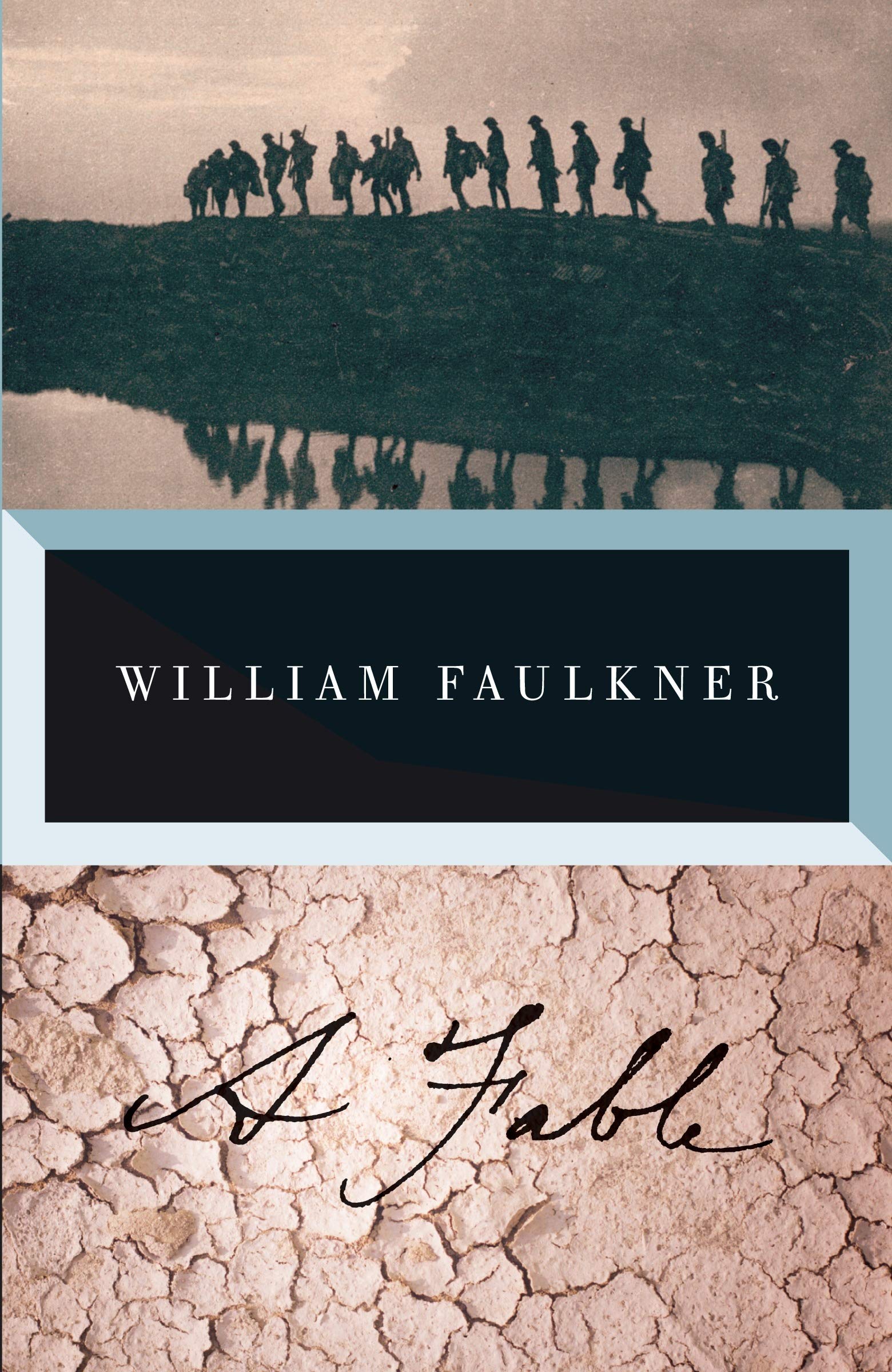
- A Fable (1954), Pulitzer Prize-winner
- The Reivers (1962) Pulitzer Prize-winner
Who Is William Faulkner?
I typically include a brief biography of the author in each of my Pulitzer Prize reviews, however since William Faulkner previously won the Pulitzer for A Fable in 1955, feel free to read my terse biography of him here.
Publisher’s Note:
The Reivers was originally published by Random House –a leading American publishing company founded in 1927. In 1934, Random House famously published the first authorized edition of Ulysses by James Joyce. In 2013, Random House merged with the Penguin Group to form Penguin Random House.
Literary Context in 1962-1963:
- Nobel Prize for Literature (1962): awarded to American author John Steinbeck (1902–1968) “for his realistic and imaginative writings, combining as they do sympathetic humour and keen social perception.”
- National Book Award (1963): awarded to Morte d’Urban by J.F. Powers.
- Aleksandr Solzhenitsyn published his classic novella One Day in the Life of Ivan Denisovich.
- James Baldwin published Another Country.
- William Barrett published Lilies of the Field.
- Jorge Luis Borges published Ficciones.
- Anthony Burgess published A Clockwork Orange.
- Philip K. Dick published The Man in the High Castle.
- Carlos Fuentes published The Death of Artemio Cruz.
- Shirly Jackson published We Have Always Lived in the Castle.
- James Jones published The Thin Red Line.
- Ken Kesey published One Flew Over the Cuckoo’s Nest.
- John Steinbeck’s published Travels with Charley: In Search of America.
- Ray Bradbury published Something Wicked This Way Comes.
- Doris Lessing The Golden Notebook.
- Vladimir Nabokov published Pale Fire.
- Madeleine L’Engle published A Wrinkle in Time.
- Ted Hughes and Sylvia Plath separated.
- Marvel Comics publishes Amazing Fantasy #15, featuring the debut of Spider-Man by Stan Lee and Steve Ditko.
Did The Right Book Win?
In my view, William Faulkner’s The Reivers is a grand step above his earlier Pulitzer Prize-winner A Fable in 1955 (click here to read my reflections on A Fable), and while I found The Reivers to be surprisingly delightful novel, I also would have considered Vladimir Nabokov’s Pale Fire and James Baldwin’s Another Country as potential contenders for the Pulitzer Prize in 1963. However, honoring Faulkner with dual Pulitzer Prizes is a fitting nod to his immensely influential literary legacy, a welcome contrast with other notorious Pulitzer snubs in the past, even if both awards were given to honor two of Faulkner’s lesser works.
Faulkner, William. The Reivers, A Reminiscence. Collector’s Illustrated Edition (Bound in German Leather), The Easton Press, Norwalk, CT, 1990 (originally published in 1962).