
On Her Majesty’s Secret Service (1969) Director: Peter R. Hunt
“We have all the time in the world…”
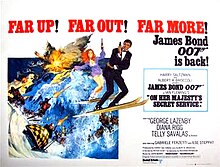
A visual feast, a rarefied gem in the James Bond franchise, On Her Majesty’s Secret Service is the first James Bond film not to feature Sean Connery in the lead role. After Connery’s decision to retire from James Bond (at the time he was not on speaking terms with producer Albert “Cubby” Broccoli), Eon replaced him with a largely unknown Australian male model named George Lazenby. Thus far, Lazenby remains the only non-European actor to portray James Bond (as of 2020). However, Lazenby greatly disliked playing the role and he ultimately decided against reprising Bond after On Her Majesty’s Secret Service. Apparently, Lazenby was also not well-liked by the film crew nor his co-stars and the mood of the production was often tense. To top it all off, Lazenby’s ego got the best of him and when he showed up to a promotional event for the film sporting a full beard (a nod to the era’s counter-culture style), the production staff was not happy. Amusingly, future Bond star Timothy Dalton had been initially offered the role of Bond in this film but he turned it down, believing himself to be too young for the part. Sean Connery did eventually return to reprise the role of James Bond in the subsequent film Diamonds Are Forever (1971), though by now he was aging out of the role. Today, On Her Majesty’s Secret Service has been undergoing a renaissance of sorts as many critics have given the film its due reappraisal, and fans of the series like Christopher Nolan regard On Her Majesty’s Secret Service as the best of the series.
On Her Majesty’s Secret Service is one of the more personal, stripped-down installments in the Bond saga –it is unique for having a tragic ending in which Bond falls in love and gets married, only for his new bride to be unceremoniously assassinated leaving Bond despondent and alone in the end. Unlike the previous Bond film, You Only Live Twice, Eon producers (Albert R. “Cubby” Broccoli) decided to make On Her Majesty’s Secret Service in a more accurate manner that closely followed the plot of the original Ian Fleming novel. The film opens with a high-speed car chase in the classic Aston Martin DBS before Bond rescues a suicidal woman on a beach in Portugal. Bond and the mystery woman are unexpectedly attacked by a pair of thugs but Bond beats them both –cue the fourth-wall-breaking line as a nod to the departure of Sean Connery, “This never happened to the other fellow.” Then we find Bond playing cards at a casino and he once again meets the woman he rescued on the beach. He saves her from disgrace when she plays at the table without any money, so she invites Bond back to her room, but Bond is attacked by an assailant inside her room (admittedly, it’s a bit difficult to decipher which room Bond visits in this sequence), but when Bond returns to his own room he finally meets the mystery woman: Contessa Teresa “Tracy” di Vicenzo (played by Diana Rigg). Note: this is a slightly different order of events than was featured in the original Fleming novel. In the book, the events are told through a flashback as Bond recalls his car chase and casino encounter before rescuing Tracy from the beach –and the casino in the book is the famous Casino Royale from the first Bond novel. The next morning, Bond is kidnapped and taken to a leading European criminal gangster named Marc-Ange Draco (Gabriele Ferzetti) who reveals that Tracy is actually his fragile, suicidal daughter. He offers money to Bond if he will marry Tracy, but Bond refuses, instead asking if Draco can help him discover the whereabouts of Ernst Stavro Blofeld (Telly Savalas) as per the Secret Service’s “Project Bedlam.” The two strike up a deal after Bond attempts to resign from MI6, but Miss Moneypenny ignores his request and instead simply requests a two week leave of absence.
In a series of utterly gorgeous scenes, Bond begins a romance with Tracy –Diana Rigg proves herself to be one of the best “Bond Girls”– and when Draco tracks down some information on Blofeld, Bond breaks into a law firm called Gumbold, which Blofeld has been in correspondence with via an apparent scientific research institute high up in the alps. The tense sequence of Bond breaking into Gumbold and copying documents is one of the most gripping in the whole series (however, since time is limited, why wouldn’t Bond simply break into Gumbold at night rather than during the day?) At least Bond manages to spot a nearby magazine with a hidden Playboy inside (naturally, Bond steals the Playboy magazine when he departs). From here, we learn that Blofeld has been trying to secure his family title as a Count, thus, after paying a visit to M’s private residence at Quarterdeck where M’s hobby is revealed to be lepidoptery (in the book, his hobby is describe as painting flowers), Bond poses as a posh English heraldry/genealogy expert named Sir Hilay Bray as he travels to the scientific research institute at Piz Gloria high up in the Swiss alps (an institute which is focused on “allergy research”). It is run by Blofeld and, predictably, the institute is filled with a dozen young, beautiful women who are all serving as patients for the study of various “allergies” (I recognized Catherine Schell from her role alongside Peter Sellers in The Return of the Pink Panther). Bond sleeps with two of the women –Ruby (Angela Scoular) and Nancy (Catherine Schell). In reality, however, Bond soon learns that the women are actually being brainwashed to distribute bacteria in a biological warfare scheme using the “Virus Omega” which will cause widespread infertility. Blofeld intends to hold the world ransom by using the brainwashed women in order to threaten global agriculture. But Bond is eventually outed as a Secret Service spy and this leads to a downhill ski chase as Bond attempts to escape to the town below amidst an incoming blizzard while being chased by Blofeld’s goons –but then, just as Bond appears ready to give up hope, Tracy suddenly appears on an ice-skating rink. They flee together and, trapped inside her room, Bond proposes marriage to her in a beautifully tender scene. The following day, the chase continues and –in a new plot-point distinct from the book– Tracy is captured, and Bond escapes from an avalanche induced by Blofeld to rescue her. He regroups with Tracy’s father, Draco, to destroy Blofeld’s facility but somehow Blofeld manages to escape. A downhill chase sees Blofeld stuck in a tree while Bond is randomly greeted by a dog in the snow (What happened here? Why doesn’t Bond simply chase after Blofeld?) Bond and Tracy are married and they drive off together along the coast while being tailed by another car. The film ends with a surprisingly tragic twist as Tracy is killed in a shockingly unexpected drive-by shooting by Blofeld and Irma Bunt. Despite the rule that James Bond never cries, here we see a fragile, emotional, tearful James Bond as the picture closes.
My favorite aspect of On Her Majesty’s Secret Service is former Bond series editor Peter Hunt’s extraordinary touch amidst a panoply of lush, rich cinematography thanks to Michael Reed and editor John Glen (a future Bond director himself). Upon a first watch, On Her Majesty’s Secret Service is rarely selected as a favorite in the series for me, however further re-watches often improve its standing –it has aged like fine wine. It is certainly a stand-out Bond film for portraying a less hokey and more “human” Bond character –much like the books wherein Bond is decidedly not portrayed as a super-human hero– and the crisp, alpine, snowy aesthetic is so strong that it makes On Her Majesty’s Secret Service a surprisingly touching Christmas classic. It is a breath of fresh air in the series. Admittedly, On Her Majesty’s Secret Service is a special and wholly unique installment the Bond franchise, however the pacing is odd and the plot is difficult to follow at points –Blofeld’s larger project is confusing to me: why destroy global agriculture and cause widespread infertility? Why is this worth ransom money to Blofeld? Why is he now intent on seeking his title as a Count from the College of Arms, thereby potentially blowing his cover? Perhaps it goes without saying, but I much prefer this stripped down version of Bond infiltrating a remote immunology clinic in the Swiss Alps tin contrast to the slapstick cohort of ninjas riddled throughout a volcano in the prior film, You Only Live Twice.
Click here to return to my survey of the James Bond saga.
Book Review: On Her Majesty’s Secret Service (1963) by Ian Fleming
- James Bond actor: George Lazenby (whenever he impersonates Sir Hilary Bray, Lazenby’s voice is dubbed by George Baker).
- Director: Peter R. Hunt
- Producers: Harry Saltzman and Albert R. “Cubby” Broccoli
- Screenplay: Richard Maibaum
- Cinematography: Michael Reed
- Editor: John Glen
- Gun Barrel Sequence: preceded by the producers credit for Harry Saltzman and Albert R. Broccoli, the gun barrel sequence is performed by George Lazenby for his one and only time (he falls to one knee which was apparently Lazenby’s own idea) and he disappears when the fake blood starts to fall down the screen.
- Villain(s): Ernst Stavro Blofeld (Telly Savalas), also known as “Comte Balthazar de Bleuchamp,” Irma Bunt (Ilse Steppat), Blofeld’s henchwoman, Grunther (Yuri Borienko) the lead henchman
- Bond Girl(s): Countess Tracy di Vicenzo (Diana Rigg)
- MI6: M (Bernard Lee), Miss Moneypenny (Lois Maxwell), Q (Desmond Llewelyn),
- Bond Gadgets: Safe Cracker device (similar to the one used in You Only Live Twice), miniature camera, “radioactive lint” mentioned by Q as a gag in the film
- Allies: Marc-Ange Draco, Head of the Unione Corse (Gabriele Ferzetti), Shaun Campbell (Bernard Horsfall), 007’s colleague who tries to aid Bond in Switzerland as part of Operation Bedlam, before being killed by Blofeld or his henchmen when Bond is unmasked as an agent.
- Blofeld’s Angels of Death:
- Ruby Bartlett (Angela Scoular)
- Nancy (Catherina von Schell)
- Anouska Hempel
- Dani Sheridan
- Helena Ronee
- Ingrid Back
- Jenny Hanley
- Joanna Lumley
- Julie Ege
- Mona Chong
- Sylvana Henriques
- Zara
- In the book, the girls are all British, but in the film they are intended to be a cosmopolitan mix of different nationalities from around the world.
- Score: John Barry
- Theme Song: “On Her Majesty’s Secret Service” instrumental by John Barry (it was used in the film as an alternative to Monty Norman’s “James Bond Theme” and is reminiscent of the instrumental theme in From Russia with Love). The unofficial theme song in this film is Louis Armstrong’s “We Have All The Time in the World” (one of his final recorded songs).
- Locales: England, Portugal, and Switzerland
- Other Notes:
- One of the jokes in the film features the janitor outside Draco’s office is whistling the theme for Goldfinger. Another joke occurs at the beginning of the film after George Lazenby beats up a pair of goons and coyly remarks “This never happened to the other guy.” Another joke occurs when Q mentions the possible use of “radioactive lint” –a jab at the gadget indulgences taken in the last few films.
- In one scene, an image of the Queen hangs on the wall at MI6 and Bond gazes up at it when considering resigning from the Secret Service (perhaps this scene is aa nod to the film’s title0.
- There was a deleted sequence in the film in which Bond is spied on by a SPECTRE agent while speaking with the heraldry expert at the College of Arms, and this leads him to chase the SPECTRE agent through the streets of London.
- Blofeld’s snowy alpine lair served as a chief source of inspiration for Christopher Nolan’s Inception.
- This film (based on the original book) first introduces Bond’s family motto as “The World is Not Enough.”
- George Lazenby essentially lied his way into the role of James Bond. He broke stuntman Yuri Borienko’s nose during a test screening of a fight scene.
Christopher Nolan has a higher view of the film.