
Alien (1979) Director: Ridley Scott
“I can’t lie to you about your chances, but…you have my sympathies.”
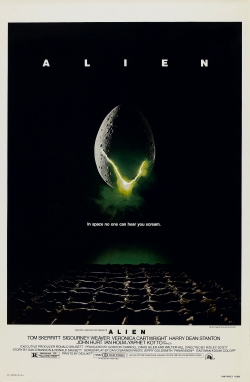

Profoundly psychological, deeply unsettling, disorienting, and atmospheric: Alien is the quintessential science fiction-horror film. Unlike many modern horror films, Alien does not rely upon indulgent green screens and excessive digital effects. Instead, the true terror occurs offscreen. It also avoids the cheap and lazy “gotcha” jump scares that seem to pervade contemporary horror movies. In my view, Alien is a perfectly paced film, allowing just enough time for the audience to experience a sense of safety and security, only for this illusion to quickly devolve into total terror –as we are left feeling entirely isolated and vulnerable. Alien was directed by Ridley Scott and it won an Academy Award for Best Visual Effects. It was a widely successful film that spawned a series of sequels, prequels, and spin-offs that continue to this day, however the original Alien remains the triumph of the series (though the sequel Aliens is also an excellent movie). After witnessing the success of 2001: A Space Odyssey in 1968 and Star Wars in 1977, 20th Century Fox was willing to pursue a science fiction survivalist film.
Building on numerous B-movie stories, the story of Alien was written by Dan O’Bannon and was pitched as “jaws in space.” The plot is as follows: A large commercial space ship called the Nostromo is returning to earth (carrying 20,000,000 tons of mineral ore). The opening scene reveals a massive spacecraft filled with many lengthy, dark, narrow hallways winding throughout. Its seven crew members are asleep in their berths in “stasis” when the ship’s computer “Mother” suddenly receives a distress call from a nearby planet. Per protocol, Mother awakens the crew. According to company policy the crew attempts to locate the call but the Nostromo receives some structural damage from the planet’s atmosphere. Down on the surface of the planet, the crew discover a massive alien spacecraft that apparently crashed long ago. Deep within the ship they find a room filled with long rows of what appear to be eggs. One of the members, Kane (played by John Hurt), is knocked unconscious when a creature springs forth from one of the egg. It breaks his helmet, and latches to his face (i.e. a “facehugger”) but Kane remains alive. The rest of the crew brings Kane back aboard the Nostromo despite the objections of Warrant Officer Ripley (played by Sigourney Weaver).
They attempt to remove the latched alien from Kane’s face until it is discovered that the alien’s blood is acidic. Eventually, the alien grows weak and falls off Kane’s face on its own –and it promptly dies. Disturbed but eager to return to normalcy, the crew decides to continue their voyage back to earth, until at dinner Kane suddenly begins convulsing uncontrollably and an alien bursts forth out of his chest, instantly killing him. The creature was gestating in his stomach. In a panic, the crew attempts to capture the new alien but it quickly escapes into the bowels of the ship and rapidly grows to full-size. The new alien “xenomorph” takes cover in the air ducts and begins killing the crew one by one. The four remaining crew members debate escaping in a pod but Ripley notes there are not enough supplies to sustain a group of four crew members.
Ripley digs into Mother’s memory banks to discover that one of the remaining crew members named Ash (played by Ian Holm) has been commanded by the company to bring the alien back to earth — she discovers that the crew is expendable on this mission. In other words, Ash has betrayed the crew. Ripley confronts Ash who begins strangling her and in the ensuing conflict it is revealed that Ash is, in fact, an android. Ash’s head is bashed in but they later reanimate Ash to learn about the unique psychology and viciousness of the alien. Ash says the alien is a “perfect organism. Its structural perfection is matched only by its hostility… I admire its purity, its sense of survival; unclouded by conscience, remorse, or delusions of morality.” He gives them a foreboding glimpse into their chances of survival so they incinerate Ash. The last two crew members are killed by the creature while Ripley, the sole survivor, initiates the ship’s self-destruct sequence and escapes in a getaway pod. Just as she is about to enter stasis she realizes the alien is actually aboard her tiny escape pod. She cleverly dons a space suit and ejects the alien through the airlock while firing the thrusters to cast the alien into the abyss. She then delivers her final log entry and then enters stasis.
“This Is Ripley, Last Survivor Of The Nostromo…Signing Off.”
Alien is rife with Darwinian themes, including a violent form of sexual reproduction akin to forced impregnation which looms like an ever-present danger over the movie. And it introduces a vicious new alien species which has evolved with the sole goal of enduring all obstacles –and to kill. Human beings have little chance of overpowering this alien creature, it is the perfect enemy. Instead they must outsmart the creature. Trapped between the vast emptiness of space, and facing a violent death aboard their ship, where will humans go to survive? There is no escape in this claustrophobic situation in space with the twin enemies of the xenomorph and also the evil corporate bureaucrats exemplified in the android Ash.
Alien represents a leading voice in the trend of science fiction films that are skeptical or perhaps even cynical of the modern scientific project. The hero, Ripley, is relatable because she wants to destroy a dangerous new creature, rather than allow a corporation to study its applications as a potential super-weapon. She does not believe human scientists have the moral culpability to handle such a dangerous and self-destructive power. In the age-old debate between whether it is better for humans to possess knowledge regardless of consequences, Ripley is a pessimist (i.e. she is not an Enlightenment enthusiast). There are all sorts of Frankenstein allusions in this film. Alien remains a towering masterpiece, an enduring movie of the highest order, one which all future science fiction and horror films should be compared to or else contrasted with. It is impressive precisely because it is a cerebral film —Alien forces the audience to think and wonder about its haunting and mysterious themes.
I always liked how naturalistic the acting was in Alien, almost to the point of eccentricity, which along with the similar acting in Blade Runner gave me a very special respect for Ridley Scott. It proved even more than Star Wars how everything would change for actors and actresses of the science-fiction cinema.