
Original Air Date: April 1, 1960
Writer: George Clayton Johnson/Rod Serling
Director: David Orrick McDearmon
“I died once, mister. I’ve been to hell. Now I’m back…”
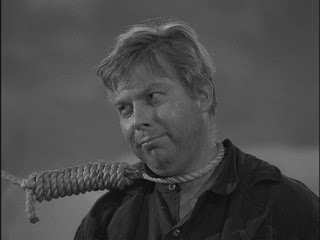
“Commonplace—if somewhat grim—unsocial event known as a necktie party, the guest of dishonor a cowboy named Joe Caswell, just a moment away from a rope, a short dance several feet off the ground, and then the dark eternity of all evil men. Mr. Joe Caswell, who, when the good Lord passed out a conscience, a heart, a feeling for fellow men, must have been out for a beer and missed out. Mr. Joe Caswell, in the last, quiet moment of a violent life.”
-Rod Serling
It is November 14, 1880. The place is the Old West. A notorious outlaw named Joseph “Joe” Caswell (played by Albert Salmi) is set to be hanged for unrepentantly shooting another man’s son in the back. But when it comes time for his death, Caswell mysteriously and spontaneously disappears leaving behind an empty noose. Eighty years later, a New York professor named George Manion (played by Russell Johnson) is seen tending to his subject, a man who has just traveled through time using the professor’s newly crafted time machine. Joe Caswell’s life was saved; he became the first person to ever experience time travel. Professor Manion tells Caswell: “You’re the first time traveler in the history of man. And I’m going to introduce you to a whole new world. And you’re going to tell me about an old one.”
At first Caswell lies about his identity, telling Professor Manion that he was a trail boss on a ranch in the territory of Montana. He says he was riding herd when he suddenly blacked out and awoke inside the professor’s laboratory. However, while dictating his observations to himself, Professor Manion confesses that he doesn’t entirely trust Caswell. He doesn’t like the look of him and he notices the deep rope burns on his neck. “I have one other observation, it’s hardly scientific. I don’t like his looks. I don’t like the eyes, or the face, or the expression. I get a feeling that I’ve taken a nineteenth century primitive and placed him in a twentieth century jungle… and heaven help whoever gets in his way.” Professor Manion later shows Caswell a glimpse of the modern, noisy, mechanical world of New York City by opening the window, and then he confronts Caswell about his rope burns, to which confesses his killed an entire territory of men, he stopped counting after twenty. Manion realizes that Caswell must be returned to 1880.
Tension builds between the two men until Caswell attacks Manion, smashing a light over his head, killing him. Caswell grabs a gun from the desk and runs out into the streets of New York City while Professor Manion’s tape recorder ominously replays his final dictates words in the backroom. But once outside, Caswell is quickly overwhelmed by the sights and sounds of cars, lights, jukeboxes, pay-phones, television, and so on. Caswell enters a bar and destroys a jukebox before firing his gun directly at the television when a Western cowboy appears starts firing. Caswell rushes back to the laboratory to plead with the now deceased corpse of Professor Manion to allow him return to his own time. But at that moment, a thief enters the lab and fights with Caswell. He strangles Caswell and then accidentally activates the time machine, himself, sending him back to 1880. His body is then found hanging from the noose intended for Caswell, befuddling all the onlookers in the old west as they wonder if some sort of “devil’s work” has been at play here.
“This is November 1880, the aftermath of a necktie party. The victim’s name—Paul Johnson, a minor-league criminal and the taker of another human life. No comment on his death save this: justice can span years. Retribution is not subject to a calendar. Tonight’s case in point in The Twilight Zone.”
-Rod Serling
My Thoughts on “Execution”
In a fascinating blend of genres, Rod Serling and George Clayton Johnson introduce us to a familiar tale of the Old West before the story is suddenly and jarringly interrupted by the “devil’s work” of modern science. Even with the advent of time travel as shown in this episode, there is still a sense of cosmic justice which has been dealt to each of the three main characters –the outlaw Joe Caswell is eventually strangled to death; Professor Manion, who has tampered on the laws of nature and accidentally given an unrepentant criminal a second chance at life, is brutally killed by that same criminal; and Paul Johnson, the thief, ultimately pays the price originally intended for Caswell, a “necktie party” hanging before being buried deep in an unmarked grave. One cannot help but recall the horror unleashed on the world by Victor Frankenstein when his own experiment became a murderer in Mary Shelley’s Frankenstein. Perhaps something similar might be said here of Professor George Manion.
“Execution” is another thought-provoking episode from Rod Serling, where the Old West meets modern science fiction, however I would submit this is not one of Serling’s best (though I do seem to hold it somewhat higher regard than other Twilight Zone fans). The death of Professor Manion felt a bit too abrupt, as did the death of Caswell by a random thief who just so happens upon the professor’s lab. It started to feel a bit too contrived by the end, and the moral sympathies of the audience is often wandering –Do we sympathize with Joe Caswell? Paul Johnson? Or Professor Manion? Perhaps of this trio, we sympathize most with the latter since he was merely acting in the pursuit of science (and our culture celebrates science for its own sake). But each of three characters has transgressed in different ways leaving behind a very bleak episode indeed. But “Execution” is still a fascinating work and it continues the frequent Twilight Zone theme of cosmic justice.
Credits:
- Director: David Orrick McDearmon
- David Orrick McDearmon (1914-1979) was a television director and actor. He directed episodes of shows like Lux Video Theatre, Peter Gunn, Tate, The Aquanauts, Bonanza, Bewitched, Gilligan’s Island, and others, including three episodes of The Twilight Zone (“Execution,” “A Thing About Machines,” and “Back There“). He was married to Twilight Zone actress Patricia Breslin, who appeared in two episodes of The Twilight Zone (“Nick of Time” and “No Time Like the Past“). They divorced in 1969 and had two children who were apparently later adopted by Breslin’s second husband, Art Modell, NFL team owner of the Cleveland Browns (later renamed the Baltimore Ravens). David Orrick McDearmon died in 1979 in Los Angeles, California.
- Written by: Rod Serling (based on a short story proposal by George Clayton Johnson)
- Music: Stock Music
- Director of Photography: George T. Clemens
- Production Manager: Ralph W. Nelson
- Art Directors: George W. Davis and Merrill Pye
- Film Editor: Joseph Gluck
- Assistant Director: Kurt Neumann
- Set Decorations: Henry Grace and Keogh Gleason
- Sound: Franklin Milton and Philip Mitchell
- Starring:
- Albert Salmi…..Joe Caswell
- Alfred “Albert” Salmi (1927-1990) was born in New York City to Finnish parents After serving in the Army during WWII, he used the GI Bill to study at the Dramatic Workshop of the American Theater Wing and the Actors Studio. Following a stint on Broadway, he turned to television acting where he appeared in over 150 film and television productions. He appeared in films like Escape from the Planet of the Apes (1971) and Caddyshack (1980); and television shows like Alfred Hitchcock Presents, The United States Steel Hour, Have Gun – Will Travel, Wagon Train, Bonanza, Voyage to the Bottom of the Sea, Daniel Boone, Lost In Space, Gunsmoke, as well as three episodes of The Twilight Zone: “Of Late I Think of Cliffordville,” “A Quality of Mercy,” and “Execution” (all of which involve time travel). He played Smerdyakov in a version of The Brothers Karamazov and he also appeared in an episode of Night Gallery (“Waiting Room” which was written by Rod Serling). He married actress Peggy Ann Garner in 1956 and they had one child together before getting divorced (their daughter Catherine died at age 38 in 1995 of heart disease). In 1964, he was remarried to Roberta Pollock Taper with whom he had two daughters. However, he apparently suffered from clinical depression in his later years. In February 1990, Albert and Roberta were separated with Roberta accusing Albert of alcoholism and abuse (she filed for a restraining order from her husband) and he moved into a home in Idaho. A few months later On April 23, 1990, she and Albert were found dead in their Spokane, Washington home by a friend who stopped by to check on Roberta. According to newspaper accounts, it was a horrid murder-suicide scene wherein Albert fatally shot Roberta in the kitchen, before turning a gun on himself in an upstairs den (different guns were used on each spouse). He was 68 years old.
- Albert Salmi was paid $1,750 for his role in this episode.
- Russell Johnson…..Professor George Manion
- Russell Johnson (1924-2014) was born in Ashley, Pennsylvania. He served in the U.S. Air Force during World War II in the Pacific theater. He flew 44 combat missions as a bombardier in B-25 twin-engined medium bombers, and on March 4, 1945, his bombardier and a couple others were shot down by Japanese anti-aircraft fire in the Philippines (not far from where Rod Serling was deployed as a paratrooper). He broke both of his ankles on the landing while his bomber’s co-pilot was killed. He received the Purple Heart for his injuries and was honorably discharged in 1945. He famously played Professor Roy Hinkley (“The Professor”) on Gilligan’s Island and Marshal Gib Scott on Black Saddle. He appeared in science fiction films like It Came From Outer Space (1953), This Island Earth (1955), Attack of the Crab Monsters (1957), and The Space Children (1958). He amusingly once participated in the satirical “Ig Nobel” award presentation ceremony in which he was credited as “The Professor Emeritus of Gilligan’s Island.” He was often typecast after his role on Gilligan’s Island, but he appeared in two episodes of The Twilight Zone (“Execution” and “Back There“) and in one episode of The Outer Limits (“Specimen: Unknown”). He was married three times and had three children (one of whom died of AIDS, leading Johnson to become an advocate for AIDS-related causes). He died of kidney failure at his home in Bainbridge Island, Washington in 2014 at the age of 89.
- Than Wyenn…..Paul Johnson, the thief (who is only named in Rod Serling’s closing narration)
- Than Wyenn, pronounced like “why-en” (1919-2015) was born in New York City. He worked o a farm in Vermont during World War II. He became a character actor whose career spanned more than forty years with more than 150 credits in film and television. He appeared in television shows like Gunsmoke, Have Gun – Will Travel, Perry Mason, Playhouse 90, The Rifleman, Route 66, Leave It To Beaver, Rawhide, Voyage to the Bottom of the Sea, The Alfred Hitchcock Hour, Get Smart, Hawaii Five-O, Mission: Impossible, but he is perhaps best known for his role in this episode of The Twilight Zone as well as roles in the films Imitation of Life (1959) and Splash (1984). He also appeared in an episode of Rod Serling’s Night Gallery (segment: “The Doll”). He was often involved in Jewish causes throughout his lifetime. He died in Woodland Hills, California in 2015 at the age of 95. He and his wife, Gertrude “Guy” Wyenn, had two sons.
- George Mitchell…..Elderly Man
- George Mitchell (1905-1972) was born in Larchmont, New York. He had minor parts in films like 3:10 To Yuma (1957), and Birdman of Alcatraz (1962) among others. He appeared on many television shows like Playhouse 90, Alfred Hitchcock Presents, One Step Beyond, Gunsmoke, Have Gun – Will Travel, Laramie, Perry Mason, The Travels of Jaimie McPheeters, Voyage to the Bottom of the Sea, Dark Shadows, Bonanza, The Time Tunnel, Land of the Giants, The Virginian, and others. He appeared in four episodes of The Twilight Zone (“The Hitch-Hiker,” “Execution,” “Jess-Belle,” “Ring-A-Ding Girl“). He was married twice and had four children. Mitchell acted in several films and television episodes with his second wife, Katherine Squire, including as an elderly couple in the Jack Nicholson film Ride in the Whirlwind (1966). Toward the end of his career, Mitchell appeared in the Robert Wise film The Andromeda Strain (1971) which was based on the novel of the same name by Michael Crichton.
- Jon Lormer…..Reverend
- Jon Lormer (1906-1986) was a character actor who appeared in many shows like Rawhide, Perry Mason, The Andy Griffith Show, Lassie, Peyton Place, Voyage to the Bottom of the Sea, and Gunsmoke, among others. But he is perhaps best remembered for his four appearances on The Twilight Zone (“Execution,” “Dust,” in which he was wrongly credited as “John Lormer,” “The Last Rites of Jeff Myrtlebank,” and “Jess-Belle“), and for his three appearances on Star Trek: first as Dr. Theodore Haskins in the unaired pilot episode “The Cage” (and also consequently in “The Menagerie, Parts I and II“), then as Tamar in “The Return of the Archons,” and finally as the Old Man in “For the World Is Hollow and I Have Touched the Sky” –he is the character who speaks the episode’s title line. He died in 1986 of cancer in Burbank, California at the age of was 79.
- Fay Roope…..Judge
- Fay Roope (1893-1961) was born in in Allston, Massachusetts and graduated from Harvard University in 1916. He worked as a character actor on television shows like The Lone Ranger, Schlitz Playhouse, Perry Mason, Rawhide, Have Gun – Will Travel, Gunsmoke, The Rifleman, Bonanza, and others. He was also an uncredited extra in films like The Day The Earth Stood Still (1951) and From Here To Eternity (1953).
- Richard Karlan…..Bartender
- Richard Karlan (1919-2004) was born in Brooklyn. He appeared in shows like The Adventures of Superman, Lassie, The Untouchables, Rawhide, Get Smart, Mission: Impossible, and others. He also appeared in two episodes of The Twilight Zone (“Execution” and “The Mirror“). He died in Los Angeles in 2004 due to pneumonia.
- Albert Salmi…..Joe Caswell
- Extras:
- Joe Haworth…..TV Cowboy (uncredited)
- Joe Haworth (1914-2000) was born in Cleveland, Ohio. He was an actor and photographer who made minor uncredited appearances in films like Gentleman’s Agreement (1947), The Caine Mutiny (1954), 3:10 to Yuma (1957), and others, as well as television shows like The Abbott and Costello Show, The Lone Ranger, Playhouse 90, The Rifleman, Laramie, Bonanza, Gunsmoke, Mission: Impossible, Little House on the Prairie, and others. He died in Santa Cruz, California in 2000 of Alzheimer’s disease.
- Joy Rogers…..Citizen (uncredited)
- Joy Rogers (1916-1998) was born in Michigan and, per her IMDB page, she has 10 credits to her name, including appearances in The Life and Legend of Wyatt Earp, Maverick, Batman, and other shows. She died in Los Angeles, California in 1998.
- Joe Haworth…..TV Cowboy (uncredited)
The Twilight Zone Trivia:
- “Execution“ is the second contribution to The Twilight Zone from writer George Clayton Johnson after “The Four Of Us Are Dying.” Ironically, both episodes share some common themes.
- “Execution” is the second Western-themed episode of The Twilight Zone after “Mr. Denton on Doomsday.”
- For this episode, CBS director of editing, William H. Tankersley, made several requested changes to the script to avoid “distastefulness,” such as a removal of a moment when Caswell was intended to spit. The network also changed a few minor lines of dialogue, such as Caswell referring to the Bibe as “that book,” and CBS’s suggestion to change Caswell from saying “I’ve been to hell and back” to “I’ve been to hell and now I’m back.” They asked that no commercial identification be visible on the bar, jukebox, or television set.
- There were two unforeseen incidents that briefly delayed production on this episode by a few hours: there was a power failure on the backlot and actor Neville Brand phoned in sick for his role as Caswell so Buck Houghton quickly made a few calls and secured Albert Salmi for the part.
- Professor Manion’s tape recorder is a Mohawk Midgitape and it apparently retailed for about $249.95 in 1960.
- Writer George Clayton Johnson met Albert Salmi on the set of this episode and later praised his style of method acting. Also, George Clayton Johnson praised Rod Serling’s dialogue changes to the original story, as well as his addition of the ending featuring the thief Paul Johnson, however he later reminded Rod that his own son was named Paul Johnson. A deeply embarrassed Rod Serling was profusely apologetic.
- Much of the equipment, dials, and machinery (and even the large transparent globe in Professor Manion’s lab) were re-used props from films like Forbidden Planet (1956), Satellite in the Sky (1956), and World Without End (1956).
- The background beeping noises heard in the time machine were later re-used in Star Trek. The same sounds had been previously used in The Twilight Zone episodes “Third from the Sun” and “Elegy.”
- When Caswell leaves the bar, he stops in front of a place called “Jim Henry’s Paradise,” the same sign was used in the film Cabin in the Sky (1943). Other signs on the street read “The Oasis Cafe,” “Loews,” “The Joint – Sodas and Sandwiches,” “Hairdressing Saloon – Haircutting and Shearing,” “Ric Club,” “Lonely Club,” Cold Beer,” “Rooms,””Capri,” “Club Bonanza,” a “Give Blood Now” advertisement, and others.
- When Caswell runs through the noisy streets of New York City, the theater advertises Doris Day in Please Don’t Eat the Daisies (a film that was released theatrically six weeks after this episode was filmed). Also, outside a movie theater, a poster can be seen advertising The Last Time I Saw Paris (1955). Both were MGM films.
- This episode takes place on November 14th in both the years 1880 and 1960.
- After “Where Is Everybody?“, “Execution” marks the second time that a frantic character locks himself inside a phone booth.
- During the hanging sequence at the start of this episode, Albert Salmi grabbed the rope and held tight to it so that when the camera panned over to his feet, it would appear as if he was truly hanging by the neck. However, the sequence was only done twice as Salmi told director David Orrick McDearmon he wasn’t sure he could hold onto long enough to do it a third time.
- The shadow of Caswell hanging was not actually actor Albert Salmi’s shadow, but rather an illusion created to highlight the vanishing effect.
- The music playing on the jukebox that Caswell destroys with a chair is a familiar song, Eric Cook’s “Turkish Delight” from the CBS stock music library. It was also featured in prior Twilight Zone episodes like “Where Is Everybody?” and “The Lonely.”
Click here to return to my survey of The Twilight Zone series.
Albert Salmi was a remarkable character actor and his death was a very sad loss.