
“Such an affair to happen on the Blue Train! It is horrible” (96).
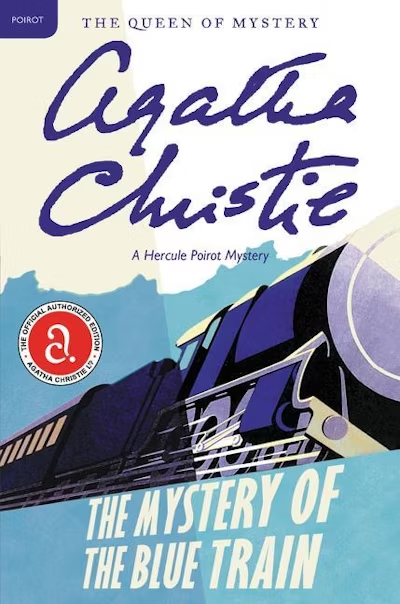
While on a trip to the Canary Islands with her daughter Rosalind in 1927, Agatha Christie sought to recover from recent stressful events in her personal life (including her infamous “disappearance” in 1926). While abroad, she completed her next contractually obligated novel, the sixth Hercule Poirot book entitled The Mystery of the Blue Train. But by her own account, this was a wholly unhappy experience. Distracted by her mounting troubles, Christie suffered from severe writer’s block. In later life, she came to regard The Mystery of the Blue Train as one of her worst books. In 1966, told an interviewer that it ‘was easily the worst book I ever wrote… I hate it.’ In her autobiography, she further described it as dull, riddled with cliches, and burdened with an uninteresting plot. It didn’t help that she was writing the novel at the same time she was divorcing her husband, Archibald, on charges of his infidelity (though curiously he was not publicly accused of cheating with his mistress, Nancy Neele, but rather with an unknown woman in a London hotel –however this was a fairly commonplace excuse for divorce in those days). Immediately after the divorce was finalized, Archibald Christie married his mistress Nancy Neele anyway and they remained together until her death from cancer in 1958. Suffice it to say, this was a very difficult period in Agatha Christie’s life and her writing at the time seems to reflect her struggle. She even wrote to her publisher asking if she could change her authorial name, but by now the name “Agatha Christie” had become synonymous with her books so her married name remained her pen name for the rest of her career.
Agatha Christie based the plot of The Mystery of the Blue Train upon one of her short stories “The Plymouth Express” in which a theft and murder occurs on the 12.14 from Paddington (“The Plymouth Express” was first published in 1923 and it was later collected in Poirot’s Early Cases in 1974). The Mystery of the Blue Train is the first Poirot novel to be written from the third person point of view. Uniquely in the novel, Hastings is wholly absent (perhaps he is off residing on his ranch in the Argentine) and maybe this is why the novel lacks some of the humor that was peppered throughout some of the earlier Poirot novels.
The Mystery of the Blue Train concerns a jewel heist by a mysterious masked figure wearing a white-haired wig named M. le Marquis. We learn that an American millionaire named Mr. Rufus Van Aldin has acquired a ruby, the “Heart of Fire,” which was once worn by Catherine the Great. The ruby is a gift for his only daughter, Ruth Kettering, a twenty-eight-year-old woman trapped in an unhappy home life with her husband, the Hon. Derek Kettering. Ruth is tall, slender, and beautiful, “at a careless glance it was the face of a Raphael Madonna.” We later learn that Ruth had married Derek simply for his title (Lord Leconbury) and in turn Derek married Ruth simply for her father’s money (since he is currently broke). However, they have both been engaging in affairs –Derek with a dancer named Mirelle who is known to dance at the Parthenon, and Ruth with a French nobleman named Armand, The Comte de la Roche. When Ruth’s father Mr. Van Aldin learns of Derek’s infidelity, he angrily pushes for a divorce. First by threatening Derek and then attempting to bribe him (both efforts fail). In both cases, Mr. Van Aldin uses his secretary as a surrogate, Major Richard Knighton. In this collapsing situation, Ruth decides to flee to France so she can be with her lover aboard The Blue Train, sometimes called “The Millionaires’ Train.” And she brings with her the new ruby from her father.
“Ruth sat very still, biting her lip and trying hard to keep the unaccustomed tears from her eyes. She felt a sudden sense of horrible desolation. There was a wild longing upon her to jump out of the train and to go back before it was too late. She, so calm, so self-assured, for the first time in her life felt like a leaf swept by the wind. If her father knew –what would he say?” (74).
At the same time, we also meet an English woman named Katherine Grey who has just received a sizeable inheritance. She hails from the village of St. Mary Mead (the future home of Miss Marple in Agatha Christie’s other famous mystery series). Katherine is taking her first trip on The Blue Train to visit her cousin, Lady Rosalie Tamplin, who resides in a villa along the French Riviera. Aboard the train, is also Derek Kettering (Ruth’s two-timing husband) –“Portrait of a lady with grey eyes. I don’t suppose I shall ever see her again”– and Ruth’s maid, Ada Mason. Under a heavy tone of fear and ominousness aboard the train, Katherine Grey encounters Ruth and they engage in friendly chatter. However, at some point between Paris and Lyon, Ruth is found murdered in her compartment, strangled to death with a black cord and her face bludgeoned to the point of being unrecognizable (the damage to her face seems to have strangely occurred after her death). Ruth’s scarlet Morocco case with the initials “R.V.K.” is found missing (with the famous ruby inside) and her maid, Ada Mason, is missing.
Who killed Ruth and stole her ruby? Was it an anonymous train robber? Was Ruth actually killed? Or was she replaced with a corpse double, hence the damaged face? Was the killer Ruth’s maid, Ada Mason? Could it have been Ruth’s unfaithful husband, Derek Kettering? Or possibly Derek’s jealous lover, Mirelle? Or Ruth’s paramour the Comte de la Roche who sent a letter convincing her to bring the ruby on the train? Or perhaps even Ruth’s own father, in disappointment over her dalliances? Mirelle secretly tries to convince the police to blame the Comte de la Roche, while Major Knighton tries to persuade Katherine to also blame the Comte. At the same time, the Comte tries to bribe Mirelle in order to blame Derek Kettering for the murder (she intends to blackmail her lover). It gets a little complex at this point. A romance subplot emerges as Katherine Grey considers potential amorous affairs with either Major Knighton or Derek Kettering, and Mirelle contemplates abandoning her penniless beau, Derek Kettering.
With M. Caux (the Commissary of Police) on the case, around this point in the novel (about 100 pages in) our favorite little genius with an egg-shaped head and a waxed mustache appears –famed Belgian detective Hercule Poirot. As previously established in the novels, Poirot is retired but he presently ‘enjoys the world.’ He once met M. Caux at the Surete in Paris. Shortly after Poirot’s appearance in the book, he is hired by Mr. Van Aldin to help find the murderer of his daughter and the thief who stole her priceless ruby.
In addition to the characters mentioned above, The Mystery of the Blue Train is known for introducing numerous other characters who are ancillary to the central plot –Mr. Goby (an information specialist who researches Derek Kettering for Mr. Van Aldin), Mary Ann Harfield (the deceased woman for who left Katherine Grey a large inheritance), George (Poirot’s valet who is sometimes addressed as “Georges”), Chubby (Lady Tamplin’s fourth husband), Lenox (Lady Tamplin’s daughter), Mr. Charles Evans (Lady Tamplin’s younger husband), Hipolyte (the Comte de la Roche’s manservant), M. Papopolous and his daughter Zia, M. Carrège (the Juge d’Instruction of the French police), Dr. Harrison and his wife (friends of Katherine Grey from the village of St. Mary Mead), along with Amelia Viner (an elderly ill woman who is friends with Katherine Grey from the village of St. Mary Mead), Demetrius Papopolous and his daughter Zia (Greek jewelers and acquaintances of Poirot), Pierre Michel (The Blue Train attendant), and Joseph Aarons (an acquaintance of Poirot who is an expert in field of acting). And while Hastings does not make an appearance in The Mystery of the Blue Train, Inspector Japp of Scotland yard is briefly referenced when Poirot wires him a message about the notorious jewel thief known only as the Marquis –“Wire me everything that is known about man whose sobriquet is the Marquis.” Who is the Marquis? Apparently, “—he is not the ordinary thief—he is more like a figure of history or romance.”
“The personality of a criminal, Georges, is an interesting matter. Many murderers are men of great personal charm” (198) -Hercule Poirot.
Solution (Spoilers Ahead)
CLICK HERE FOR SPOILERS
After the Comte de la Roche falls under scrutiny and later Derek Kettering is arrested by the French police, Poirot miraculously solves this confusing case –but only after traveling on The Blue Train again with Mr. Van Aldin and his secretary Major Knighton.
Who killed Ruth Kettering and stole her ruby? “Her name –or the name under which she was known, for many years—is Kitty Kidd, but you, Monsieur Van Aldin, knew her by another name –that of Ada Mason” (283). Yes indeed, the killer was Ruth’s own maid, Ada Mason, who is secretly the actress known as “Kitty Kidd.” But she also had an accomplice, Mr. Van Aldin’s secretary Major Richard Knighton (later revealed to be the notorious “Marquis” jewelry thief). He developed a fake story of being a war hero with a leg injury that forced him to recover at a war hospital twelve years ago. Both Mason and Knighton were hired at the same time by their respective employers two months ago. And Mason’s only alibi for being spotted at the Ritz was a fraudulent story by Knighton. The two worked together –after Mason strangled Ruth to death, Knighton stole the ruby and stepped off the train, while Mason (an actress) donned her mistress’s clothes and made herself seen on the train (thus making it seem like Ruth was still alive) and she even spoke with the train conductor, thus further cementing the alibi. Poirot arranges for the police to arrest them both, preventing Knighton “The Marquis” from escaping again.
I found The Mystery of the Blue Train to be another terrific second-tier Agatha Christie Poirot mystery. Admittedly, I am a sucker for the classic train-murder mystery motif. While I understand many of the criticisms of this book –too many characters, too many cliches—however I still found it to be another delightful mystery, even though this is not on par with Murder on the Orient Express. Notably, there is a strange touch of the supernatural in this novel as Katherine Grey mysteriously feels the spiritual presence of the late Ruth who seems to be trying to tell her something from beyond the grave (this brief moment offers a rare overlap between Katherine’s ghostly superstition and Poirot’s cold, meticulous Enlightenment rationalism). I was careful to clock this moment wherein Christie seems to demonstrate a certain fascination with the super natural, while ultimately reserving her faith for the light of reason. The Mystery of the Blue Train also highlights certain tensions between the limits of wealth in the United States versus wealth in Europe. An American like Mr. Van Aldin is often simply referred to as “The Millionaire” and his money allows him to acquire the rare ruby for his daughter (though he is unfortunately blinded by Major Knighton’s claims to be an honorable man), whereas on the flipside, European aristocrats like Lady Tamplin seem to be uninterested in flashy things like “Heart of Fire” ruby. Perhaps they would have been unlikely to be quite so trusting of a man like Knighton. In other words, the Americans like Mr. Van Aldin and his daughter Ruth seem to be less capable of managing their wealth and privilege, thus unwittingly opening themselves up to swindlers like Mason and Knighton.
Lastly, the novel ends with a fairly cliché coda as Poirot speaks with Lenox at Lady Tamplin’s villa –“Trains are relentless things, aren’t they, Monsieur Poirot? People are murdered and die, but they go on just the same.” Poirot encourages her to trust the train as a metaphor for life, she will find love one day.
Christie, Agatha. The Mystery on the Blue Train. HarperCollins. NY, NY, 1928.
Dedicated “To the two distinguished members of the O.F.D. Carlotta and Peter.”
Your review of The Murder on the Blue Train offers a clear and engaging exploration of one of Agatha Christie’s classic mysteries. I appreciate how you highlight both the intricate plotting and the atmospheric setting, providing readers with a balanced perspective that honors Christie’s storytelling prowess. Your insightful commentary makes this review a valuable resource for both longtime fans and newcomers to her work. Thank you for sharing such a polished and thoughtful analysis.
Thank you very much! Kind regards-