
From Russia with Love (1963) Director: Terence Young
“My orders are to kill you and deliver the Lektor… how I do it is my business.”
★★★★★
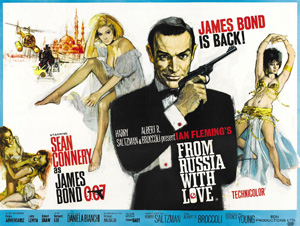
The second James Bond film (based on Ian Fleming’s 1957 novel of the same name) was again directed by Terence Young, director of three early Bond films: Dr. No, From Russia with Love, and Thunderball. After the tremendous success of 1962’s Dr. No, United Artists quickly pushed for a sequel to be released by Eon (with a budget increase from $1M to $2M), and the film was rushed to completion by October 1963. In spite of its hurried schedule, From Russia with Love stands head and shoulders above many of the other Bond films as one of the closest adaptations of Fleming’s original source material. Fleming wrote the novel at his “Goldeneye” estate in Jamaica according to his typical writing pattern of writing for three hours each morning, and then again for an hour in the evening. He never looked back at what he wrote nor did he do much editing prior to finishing the book, and this way he could write approximately 2,000 words per day. It was only after the book was complete that he went back and edited the text. By this point, Fleming considered killing his “muse,” James Bond, but eventually he was persuaded to continue the series. Published in 1957, President John F. Kennedy famously named From Russia, with Love as among his top ten books of all time (as published in Life Magazine). Interestingly enough, the 1963 film adaptation was also the last film President Kennedy saw at the White House before he left for Dallas and was tragically assassinated.
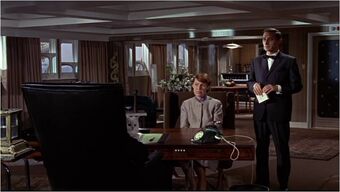

The story for From Russia with Love is a Cold War classic. The film opens with an ominous prologue at a vast luxurious estate (this was originally set to be placed after the credits but it was moved to prior, filed at Pinewood Studios and it is a nod to the arthouse cult film Last Year at Marienbad) –Bond is on the run through a hedge maze until he is suddenly attacked and strangled by “Red Grant” (played by Robert Shaw, famous for his portrayal of Henry VIII in A Man For All Seasons and Quint, the old griseled shark-hunter in Jaws). “Red Grant” is a ruthless assassin employed by the criminal organization known as SPECTRE (called “SMERSH” in the novels, but changed to a multi-national criminal organization to avoid the politics of direct association with the Russians, but the implication is nevertheless clear). “Grant’s one of our best men. Homicidal paranoiac, superb material. His response to our training and indoctrination have been remarkable.” The lights come up and we learn this has all merely been a drill, with a man in a mask pretending to be Bond for this particular training exercise. Next, a global chess master and top leader at SPECTRE named Kronsteen (director of planning for SPECTRE and “Number 5” played by Vladek Sheybal) has devised a plan to steal a Lektor decoding machine from the Russians (the machine was ironically called “Spektor” in the novel), in the hopes of selling it back to them. SPECTRE believes that the British Secret Service will not pass up a chance at acquiring a Lektor decoder and they will almost certainly use their best agent, James Bond, which will allow SPECTRE to take revenge on him and MI6 for the killing of Dr. No in the previous film (“let his death be a particularly unpleasant and humiliating one”). The Chief Executive of SPECTRE is anonymously known as “Number 1” –we never see his face, but we can see his fish tank filled with Siamese fighting fish and his fluffy, white cat in these iconic opening scenes (we later learn he is the infamous Ernst Stavro Blofeld). Thus, SPECTRE devises an elaborate espionage plot to be carried out by the sadistic “Number 3” or Rosa Klebb (played by Lotte Lenya) a former Soviet military leader. Klebb hires the assassin from the film’s prologue, Red Grant, to tail James Bond and then kill him after retrieving the Lektor device, and she also hires a Soviet corporal of state security from Istanbul named Tatiana “Tania” Romanava (played by Italian actress, Daniela Bianchi, whose accent was so thick for this role. that it required over-dubbing throughout the entire film). Klebb instructs her not to tell anyone or else she will face death —“Come, come, my dear. You are very fortunate to have been chosen for such a simple, delightful duty — a real labor of love, as we say…”
Back in London, Bond is running late to headquarters (he is caught up with his girlfriend named Sylvia Trench who has missed him since he was gone in Jamaica in the previous film) but once he arrives, M informs Bond that a cipher clerk named Tatiana Romanava has decided to defected to Great Britain and she is offering a valuable Lektor device, but she will only defect if it is directly to James Bond (she claims to have fallen in love with Bond based on Soviet file photos). Bond senses a trap, but travels to meet with her in Istanbul anyway –he has been outfitted by Q Branch with a trick briefcase and several gadgets. Before departing for the airport, Bond leaves behind a file photo of Romanova, writing “From Russia with Love” on it for Miss Moneypenny.
Bond meets up with his contact, Ali Kerim Bey (named Darko Kerim in the novel and played by Pedro Armendáriz) and tailed by Red Grant, a wild attack scene ensues with Bulgarians who try to kill Ali Kerim Bey with a limpet mine, this is followed by a brief stop in the underground catacombs beneath Istanbul and a visit to a group of gypsies where two women begin fighting to the death in a bizarre sexualized scene –but it is interrupted when Bond and Ali Kerim Bey are attacked by the Bulgarians again (Bond is secretly saved by Red Grant’s sniper fire). This leads Bond and Ali Kerim Bey to snipe the main Bulgarian assassin, Krilencu, as he attempts to climb out his window via the mouth of an actress on a giant billboard (in the book it is Marilyn Monroe).
Bond returns to his hotel to find Tatiana “Tania” Romanava lying naked in his bed (they are secretly recorded through a double mirror above the bed by SPECTRE agents). Bond tails Romanava to the Hagia Sophia and, thanks to Grant killing the Bulgarian operative, Bond easily retrieves the secret consulate plans. He records Romanova detailing the schematics of the Lektor which leads M to believe it is an authentic device (the scenes of M and his associates listening to the recording are laugh-out-loud funny!) Then, in an iconic scene, Bond and Romanava escape aboard the Orient Express with the Lektor they have stolen from the Russian consulate. They go undercover as David and Caroline Somerset, and Ali Kerim Bey is tragically killed in a struggle with an assassin named Benz (both men kill each other). Bond then rather shockingly violently confronts Romanova over Ali Kerim Bey’s death. Always lurking in the background is the blond-haired Red Grant –one of Bond’s greatest foes. In a surprise twist, a British agent named Captain Norman Nash arrives and he claims to have been sent by M (we, in the audience, know this is Red Grant). He drugs Romanava’s drink at dinner and then overpowers Bond in a tense hand-to-hand combat scene. Grant reveals that the whole plot was not SMERSH as Bond had suspected, but rather SPECTRE. In a somewhat silly and unbelievable move, Bond tricks Grant to open his suitcase which is booby-trapped, Bond then stabs and strangles Grant, and he escapes with a barely-conscious Romanava into a getaway car that was intended for Grant.

Back at SPECTRE, “Number 1” (or Blofield) confronts Klebb and Kronsteen for their terrible failure. Kronsteen is surprisingly executed on the spot with a poison-tipped switchblade hidden in a shoe. Klebb is offered one last chance to redeem herself and recapture the Lektor. Meanwhile, Bond and Romanava are escaping via Grant’s planned escape route. They destroy a helicopter (an allusion to Alfred Hitchcock’s North by Northwest) and then commandeer a boat off the coast of Croatia while destroying several SPECTRE boats in a dramatic boat chase scene. Bond and Romanava reach a hotel room in Venice, but Klebb suddenly appears disguised as a hotel maid (this is different from the conclusion to the book in which Bond pays a visit to Klebb’s hotel room in Paris). Another interesting difference from the book is that Kronsteen is killed by poison in the movie (his fate remains unknown in the novel). At any rate, Klebb tries to steal the Lektor and, still believing Romanava is working on her side, Klebb is surprised to find Romanava fire a shot and betray her. With Klebb dead, Bond and Romanava float away on a romantic gondola through Venice –and Bond tosses the reel of blackmail film footage to be used against him into the water, bidding it farewell as he and Romanova drift away together.

From Russia with Love is notably the first Bond film to officially feature Desmond Llewelyn as Q, a role he would reprise for 30+ years in every future Bond film (save for two) until his death around the time of The World Is Not Enough in 1999. It represents the start of many future gadgets in the Bond oeuvre. Also, From Russia With Love was the second of seven Bond films to star Sean Connery, whom many regard as the greatest of all the James Bond actors (myself included). But the villains shine equally in this film –the sadistic duo of Kronsteen and Klebb, the mysterious “Number 1,” and Bond’s blond-haired foil, Red Grant. Amusingly enough, there is an underground fan theory that Daniel Craig’s portrayal of Bond is actually “Red Grant” reborn (as a result of their similar blond-haired appearances). However, the shadowy faceless villain only known in the film as “Number 1” is the true over-arching nemesis at this point in the series. “Number 1” is played by the same actor who played the mischievous R.J. Dent from Dr. No (Anthony Dawson). Over the years, rumors have swirled about a possible secret Ian Fleming cameo in this film (one theory suggests he appears outside the Orient Express in a grey sweater since he is known to have visited the set and witnessed the Orient Express filming scenes), however this theory has never been either confirmed or denied. Apparently, Alfred Hitchcock was originally considered to direct this film, but after Vertigo tanked at the box office, Eon looked elsewhere for director –imagine that!
While upon first viewing, the plot to From Russia with Love can be a bit difficult to track at times with the various competing narratives of MI6, the Soviets, and all the double-crossing within the secret organization known as SPECTRE, however I can personally attest that reading the original Ian Fleming novel helps to illuminate many of the mysteries in the film. In my view, From Russia With Love is simply a quintessential Bond film –one of the best in the whole series. The last Bond film released while Ian Fleming was still alive, From Russia with Love is rumored to be Sean Connery’s favorite Bond film, and it is hard to disagree with his assessment.
Click here to return to my survey of the James Bond saga.
Book Review: From Russia, with Love (1957) by Ian Fleming
- James Bond actor: Sean Connery
- Director: Terence Young
- Producers: Harry Saltzman and Albert R. “Cubby” Broccoli
- Screenplay: Richard Maibaum and Johanna Harwood, adapted from Ian Fleming’s novel
- Cinematography: Ted Moore
- Editor: Peter Hunt
- Gun Barrel Sequence: completed by stunt-man Bob Simmons (the same spherical clip was used in Dr. No and Goldfinger, as well)
- Villain(s): Red Grant (Robert Shaw); Colonel Rosa Klebb (Lotte Lenya); Kronsteen (Vladek Sheybal); and “Number 1” (Anthony Dawson)
- Bond Girl(s): Tatiana “Tania” Romanova (Daniela Bianchi); and briefly Bond’s girlfriend in the early films, Sylvia Trench (Eunice Gayson)
- MI6: M (Bernard Lee), Miss Moneypenny (Lois Maxwell), and Boothroyd, head of MI6 Q Branch and the equipment officer (Desmond Llewelyn)
- Bond Gadgets: Trick briefcase, bug detector of phone taps, tape recorder camera used to interrogate Tanya
- Allies: Ali Kerim Bey (Pedro Armendáriz)
- Score: John Barry, including a wonderful instrumental that plays over the opening credits (Matt Munro’s title theme only appears at the end of the film)
- Theme Song: Matt Munro’s “From Russia with Love” (written by Lionel Bart)
- Locales: Venice, Istanbul, and the Orient Express across Europe (in Yugoslavia)
Comment